Recipe Revelations

Saving them for later; perfectly fine excuses to postpone the New Year's diet for yet a few more days.

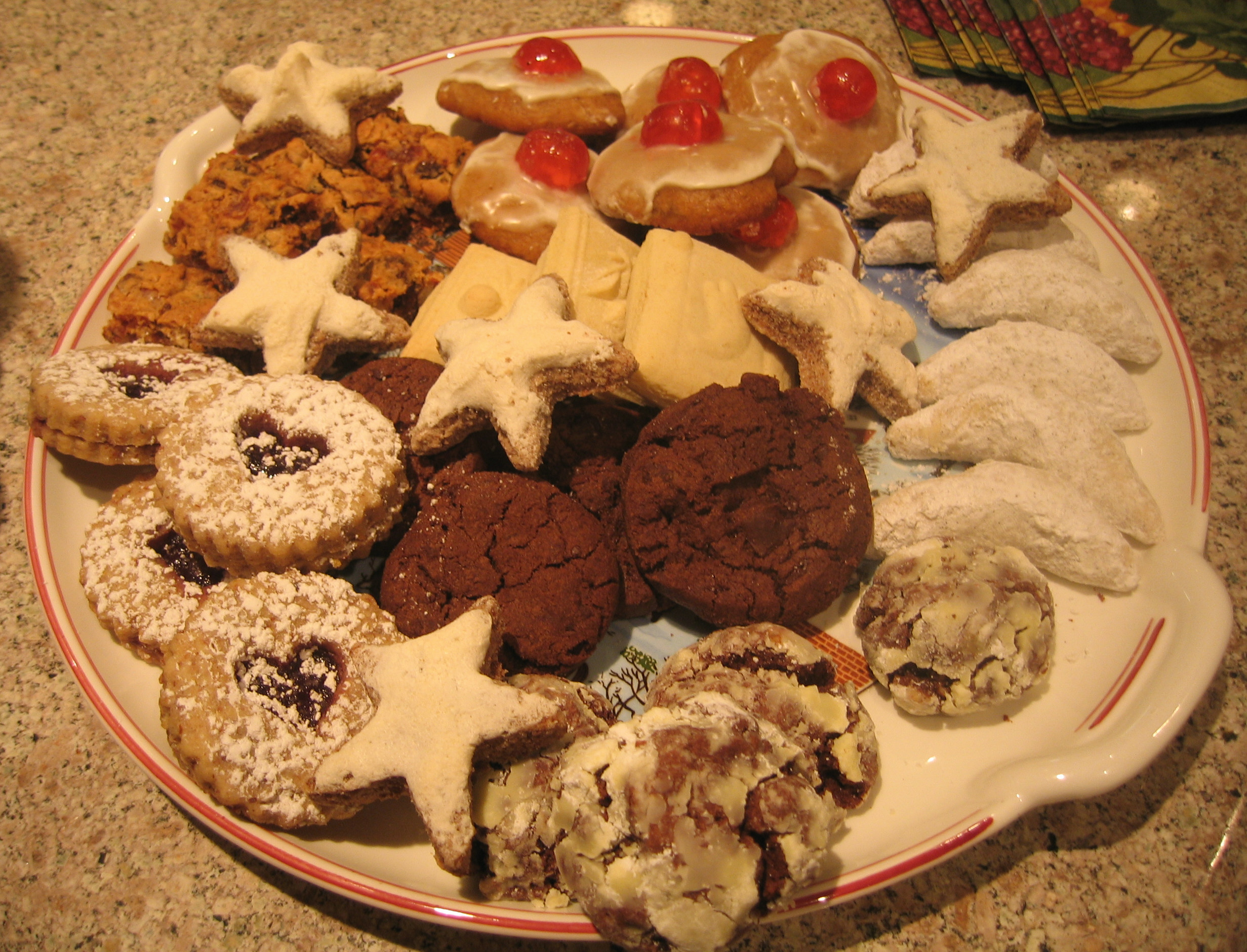
I am still savoring my last few Lebkuchen and Springerle cookies.  Lucky for me, those two varieties keep fresh in their tins for weeks into the New Year.  I take immense pleasure in dipping my Springerle into a hot cup of Chai tea, and the Lebkuchen – well, they are good anytime of day or night, especially with a tall glass of cold milk.  I am always amazed at how long the Lebkuchen stay fresh and flavorful.  My durable but dwindling supply of Springerle and Lebkuchen are a great excuse to postpone my New Year’s diet for just one more week.

Now that the holidays are over, I am grateful that my mother, father and I had the chance to catalog, digitize, and share her time-worn, dog-eared, file folder of recipes.  It has been likewise satisfying for me to talk to my mother and father about their holiday recollections and traditions.  How is it that looking at old recipes and eating favorite Christmas cookies can conjure up so many memories?

Speaking of recipes, I have learned during the past few months, while working on this blog, that recipes have really changed and evolved since the 1950s.  My mother still has her Gourmet cookbooks, even the very first one from 1956.  Flipping through it, you notice right away how short and tersely written the recipes are, and there are little drawings instead of photographs in the margins. As my mother explains to me, “Those recipes were for people who already knew how to cook, they were not for ingénues.”
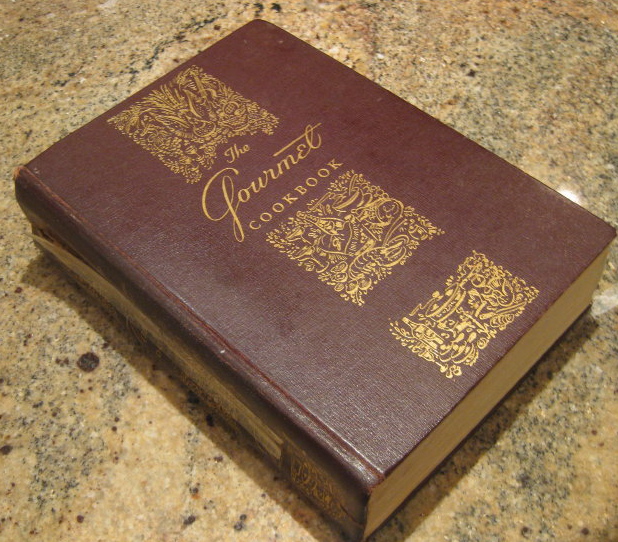
The first Gourmet cookbook (1956 8th ed.) given to my mother by my father when they were newlyweds.

Below is the recipe my mother still uses for Lebkuchen, from the first Gourmet cookbook.  It is a bit intimidating.  There is no separate list of ingredients, and instructions are vague at best.  What is a very hot oven?  How do you scald honey?  Do you use a standing mixer?  How much icing should you make?  How long to bake the cookies?  By comparison, recipes today are totally user friendly, with detailed shopping lists, gorgeous photographs and step-by-step instructions.
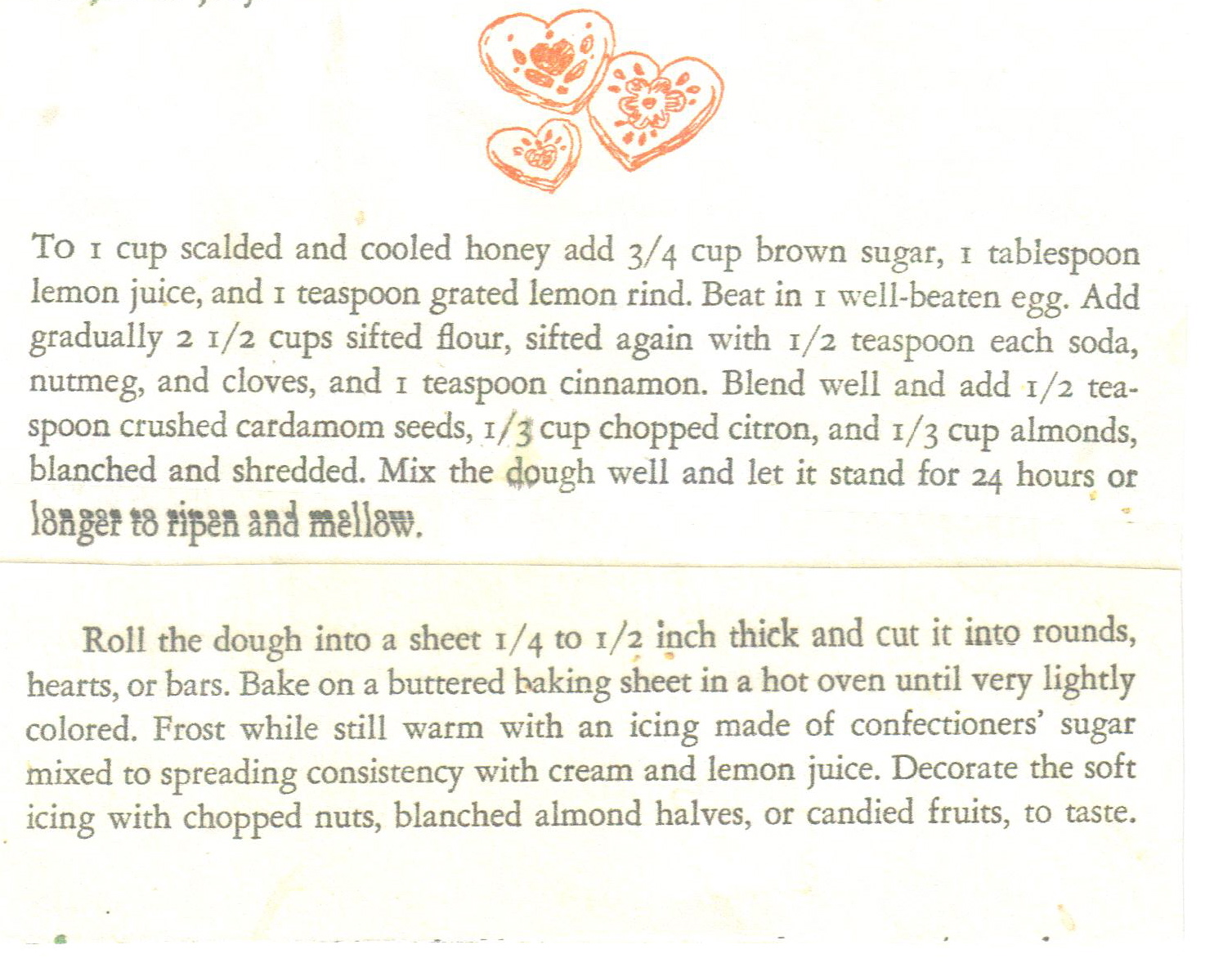
A well-used copy of the Lebkuchen recipe in the first Gourmet cookbook.

My mother’s talent for and love of cooking that started in the 1950s obviously did not come from today’s Cooking Channel shows, an iPad app, or a high-price cooking tour of Rome or Paris.  Her skill is the product of trial and error, good old fashioned hard work, and an innate desire to make other people happy by serving them with her delicious food.   Without hesitation, however, Ruth credits the iconic Julia Child for inspiring her to cook, through her 1960s television show, The French Chef.   In turn, I am inspired by my mother, for her dual passions in the kitchen to try new things and to keep old traditions alive.
Posted in Uncategorized | Tagged , , | 6 Comments

Sablés Korova — The Chocolate-Chocolate Chip Cookie You’ve Been Waiting For

the Korova is an easy to make slice and bake chocolate-chocolate chip cookie

The very first time my mother took a bite of a Korova cookie, she knew it was the chocolate-chocolate chip cookie she had long been waiting for.  Ruth and friend of hers were at a cooking demonstration at the James Beard House in Greenwich Village, and Dorie Greenspan was there preparing a handful of recipes, including the Sablés Korova, from her 2002 book called Paris Sweets: Great Desserts from the City’s Best Pastry Shops.  Ms. Greenspan was as delightful as her travel-recipe book, my mother says; she signed my mother’s copy of Paris Sweets, and the Korova cookie has been a family favorite of ours ever since.

True, the Paris-inspired Korovas are not traditional German Christmas cookies.  But I am pretty much addicted to them any time of the year.  They are pleasingly dark chocolate throughout, with a hint of sea salt that makes you want to eat just one more.  The real bonus is that they are an easy to make, slice and bake variety, and you can keep the dough in the refrigerator or freezer until you are ready to slice and bake them.   I guess you could say that the holiday season is just another great excuse to make and enjoy this decadently delicious chocolate-chocolate chip cookie.

Recipe for Korova Cookies – Sablés Korova

From Dorie Greenspan’s Paris Sweets; Great Desserts from the City’s Best Pastry Shops (Broadway Books 2002).  The book’s recipe is adapted from Pierre Hermé Paris.

Ingredients:

1¼ cup all-purpose flour
1/3 cup Dutch-process cocoa powder
½ teaspoon baking soda
1 stick plus 3 tablespoons unsalted butter, at room temperature
2/3 cup packed light brown sugar
¼ cup granulated sugar
½ teaspoon fleur de sel, or ¼ teaspoon fine sea salt
1 teaspoon vanilla extract
5 ounces bittersweet chocolate, chopped into small bits (Valrhona Guanaja is Pierre’s choice)

Preparation:

Sift the flour, cocoa, and baking soda together and keep close at hand.  Put the butter in the bowl of a mixer fitted with the paddle attachment and beat on medium speed until the butter is soft and creamy.  (Alternatively, you can do this and all subsequent steps by hand, working with a sturdy rubber spatula.)  Add both sugars, the salt, and vanilla extract and beat for another minute or two.  Reduce the mixer speed to low and add the sifted dry ingredients.  Mix only until the dry ingredients are incorporated – the dough will look crumbly, and that’s just right.  For the best texture, you want to work the dough as little as possible once the flour is added.  Toss in the chocolate pieces and mix only to incorporate.

Turn the dough out onto a smooth work surface and squeeze it so that it sticks together in large clumps.  Gather the dough into a ball, divide it in half, and working with one half at a time, shape the dough into logs that are 1½ inches (4 cm) in diameter.  (Cookie dough logs have a way of ending up with hollow centers, so as you’re shaping each log, flatten it once or twice and roll it up from one long side to the other, just to make sure you haven’t got an air channel.)  Wrap the logs in plastic wrap and chill them for at least one hour.  (Ruth saves and uses the inner cardboard tubes from paper towel rolls an uses them as reinforcements outside of the plastic wrap; the cardboard rolls also help shape the dough into uniform logs.)  Wrapped airtight, the logs can be refrigerated for up to 3 days or frozen for 1 month.

shape the dough into logs and chill before slicing and baking; Ruth uses cardboard inserts from paper towels to help shape the logs and protect them while in the freezer or refrigerator

Center a rack in the oven and preheat the oven to 325°F (165°C).  Line two baking sheets with parchment paper and keep them close at hand.

Working with a sharp thin-bladed knife, slice the logs into rounds that are ½ inch (1.5 cm) thick.  (Don’t be upset if the rounds break; just squeeze the broken off bit back onto the cookie.)  Place the cookies on the parchment-lined sheets, leaving about 1 inch (2.5 cm) space between them.

use a sharp knife to slice the dough, and don't despair if the slices crumble, just squeeze it all back together (really!)

Bake only one sheet of cookies at a time, and bake each sheet for 12 minutes.  The cookies will not look done, nor will they be firm, but that’s just the way they should be.  Transfer the baking sheet to a cooling rack and let the cookies stand until they are only just warm or until they reach room temperature – it’s your call.  Repeat with second sheet of cookies.

Recipe’s Note:  The dough can be made ahead of time and chilled or frozen.  If you’ve frozen the dough, you needn’t defrost it before baking – just slice the logs and bake the cookies 1 minute longer.  Packed airtight, the baked cookies will keep at room temperature for up to 3 days; they can be frozen for up to 1 month.

An American in Paris:  Ms. Greenspan also adds at the end of her recipe that she has added chopped toasted pecans, plumped currants, and pinch of cinnamon to the dough and loved it.  When she is out of Valrhona Guanaja, the preferred chocolate for these cookies, she has used store-bought chocolate chips.

Posted in Uncategorized | Tagged , , , , | 2 Comments

Chocolate Sambuca Crinkles — A Sophisticated Cookie

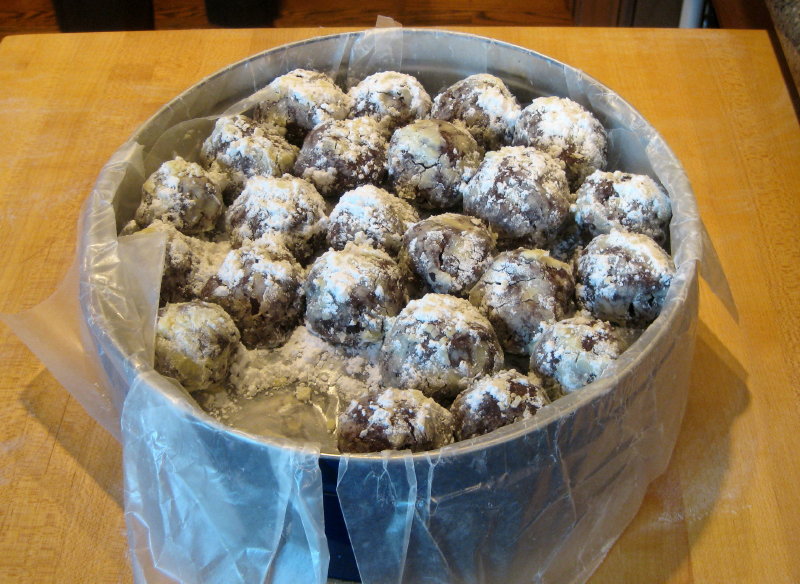
Chocolate Sambuca Crinkles are always ready for a party

This chocolate cookie is a sophisticated, not-for-the-kids confection, laced with Sambuca, an anise flavored liqueur, and loaded with chopped bits of walnuts.   It has a crunchy sugary outside, and a moist and flavorful inside.  The coating of powdered sugar presents a festive look for the holidays, but these spirited cookies would be perfect for a dinner party dessert any time of year, served with a glass of port wine or a Sauternes.

My mother likes these cookies because they add a note of modern jazz to the classic composition of her holiday cookie assortment.  She found this recipe in a December 1999 Gourmet magazine, and always comes back to it when she has the luxury of time – after her traditional German cookie assortment is complete.

Recipe for Chocolate Sambuca Crinkle Cookies

Recipe is from December 1999 Gourmet magazine
Makes about 2½ dozen cookies
Active time: ½ hour; start to finish: about 3 hours

Ingredients:

1¼ cups all-purpose flour
1 tablespoon baking powder
½ teaspoon salt
12 ounces fine-quality bittersweet chocolate (not unsweetened), chopped
½ stick unsalted butter
2 large eggs
½ cup walnuts, coarsely chopped
½ cup Sambuca or other anise-flavored liqueur
2 tablespoons granulated sugar
1 cup confectioners sugar

Preparation:

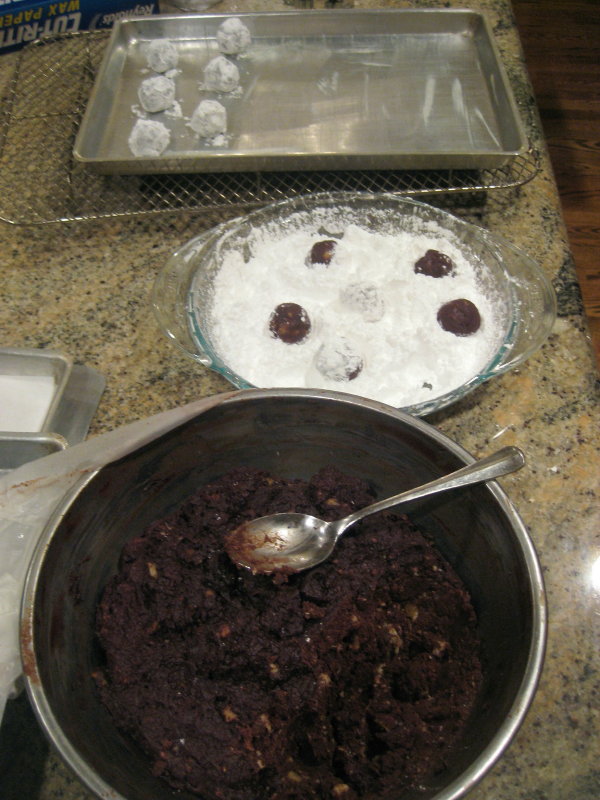
Sift together flour, baking powder, and salt.  Melt chocolate with butter in a metal bowl set over a saucepan of simmering water, stirring until smooth.  Lightly whisk together eggs, walnuts, Sambuca, and granulated sugar in another bowl.  Stir in flour mixture and chocolate (dough will be thin).  Chill, covered, until firm, about 2 hours.

chilled dough being shaped into balls and dipped in confectioners sugar before baking

Preheat oven to 350 degrees.

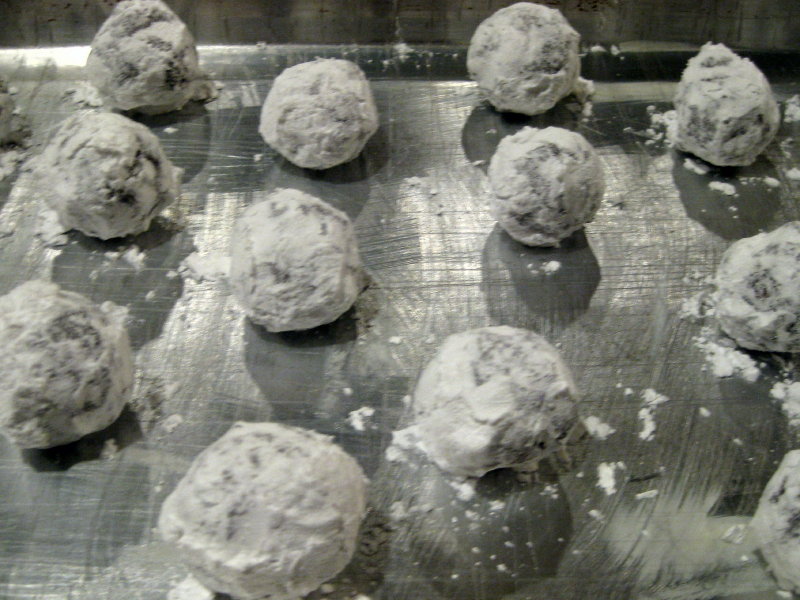
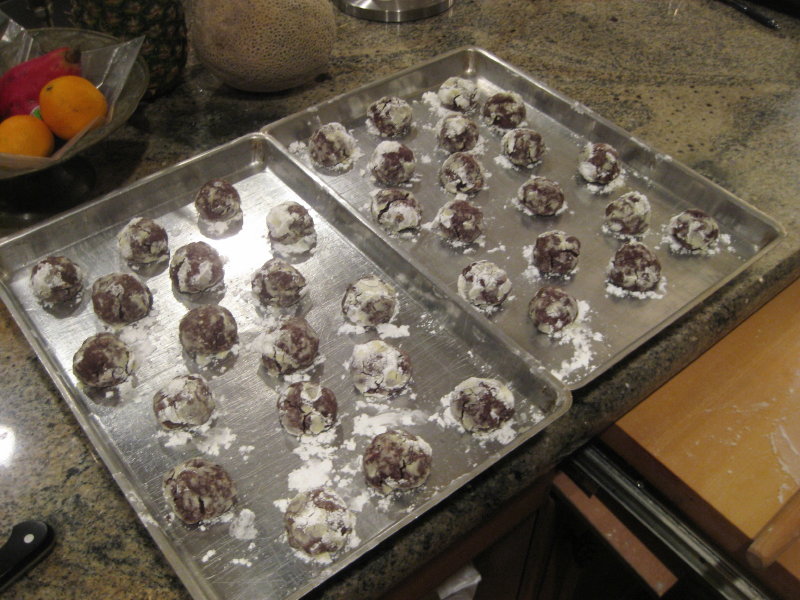
Sift confectioners sugar onto a plate.  Roll heaping tablespoons of dough into balls and roll balls in confectioners sugar to generously coat.  Arrange balls 2 inches apart on 2 lightly buttered baking sheets and bake in upper and lower thirds of oven, switching position of sheets halfway through baking time, until puffed and cracked but centers are still a bit soft, 10 to 15 minutes total.  Transfer to racks to cool.

Sambuca cookies before baking

cooling and crinkling chocolate cookies, just out of the oven, getting ready for all that jazz -- enjoy!

Posted in Uncategorized | Tagged , , | Leave a comment

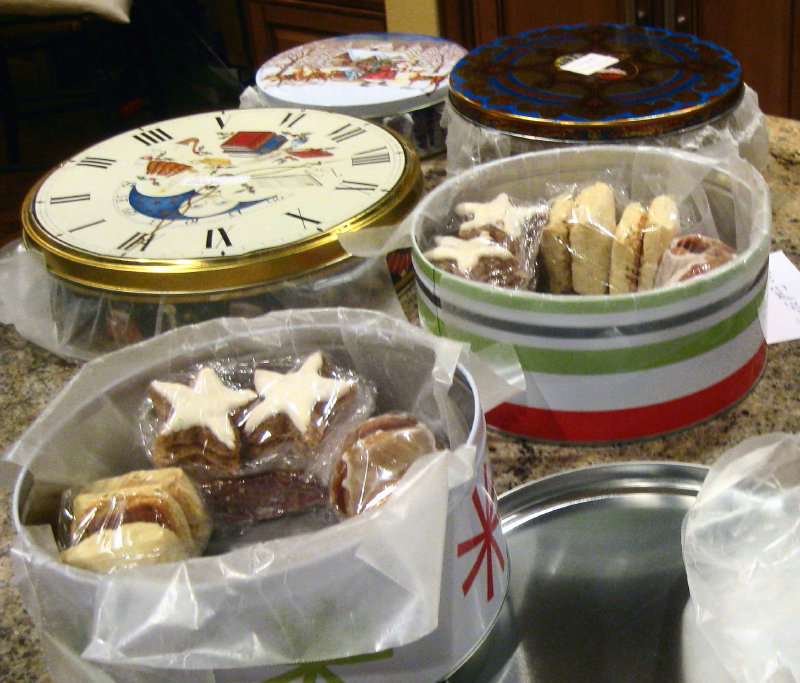
Ruth’s Cookie Tins — Full of Love and Hard Work

Christmas Day was yesterday, and I still have two more recipes to share, for Chocolate-Chocolate Chip Korova cookies and Chocolate Sambuca Crinkle cookies.  Coming soon!

My mother bakes faster than I can type!

Who will be lucky enough to get one of these tins of Ruth's Christmas cookies? Me, for one.....

In the meanwhile, since Thanksgiving week, Ruth has baked Stollen and nine varieties of cookies, mostly in double or triple batches.  And I managed to bake one, yes only one, recipe for the Ausstecherle Butter Cookies.  My mother is incredibly industrious and exceptionally focused in the kitchen, don’t you agree?  How does she do this?  And on Christmas Eve she made a full holiday dinner for my brother’s family with hand made Spaetzle, a pork roast with gravy, and an Apfel Kuchen to accompany all those Christmas cookies for dessert.  Mom, you are amazing!

She and my Dad also found the time to ship two tins of cookies to us in Lake Tahoe, where I am spending the holidays with my husband and two sons.  Not a lot of snow for skiing, but the Sierras are still a very beautiful and peaceful place to be.  My mother’s cookies and Stollen are being consumed at a very fast pace, and taste simply delicious in this sweet mountain air.  Happy Holidays!

Posted in Uncategorized | 3 Comments

Linzer Cookies — Always Welcome

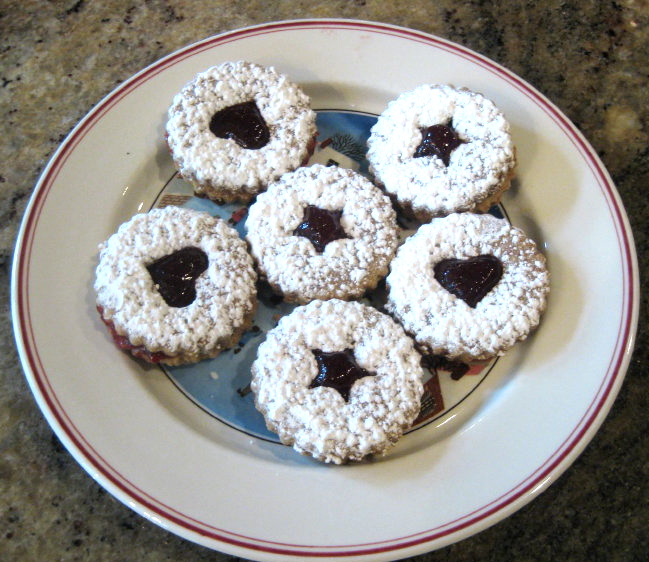
Linzer cookies are always a big hit, any time of year

Linzer cookies are a spin off of a Linzer torte, a classic Austrian confection featuring the wonderful combination of raspberry preserves with a mix of ground hazelnuts and almonds.  My mother’s Linzer cookies are an all-time favorite of my older son Spencer, who loves the tang of raspberry melded together with the moist texture and rich flavors of the ground nuts.  I think he has always liked them because my mother takes the extra step of straining the preserves, to get rid of the pesky seeds, making them totally kid-friendly.

My mother has tried several Linzer cookie recipes over the years and likes this one the best.  It is a “consistent” recipe, she says, that produces darling little sandwich cookies.  She prefers King Arthur’s all-purpose flour for her baking, and for her Linzer cookies she uses a special cookie cutter she ordered from the King Arthur catalog several years ago that has interchangeable cut out designs for the cookie top.  Linzer cookies are a perfect addition to the holidays, yet they are also sweet for Valentine’s Day, especially if you use a heart-shaped cookie cutter.  I could eat them anytime of year, especially when they are made with love by my dear mother, Ruth.

Recipe for Raspberry Linzer Cookies

Based on a Winter 2003 Fine Cooking recipe by Elaine Khosrova
Makes about 32 2 ½ inch sandwich cookies
Active time: about 1 hour; start to finish: about 3 hours

Ingredients:
2 ½ ounces (½ cup) sliced almonds
2 ½ ounces (½ cup) coarsely chopped hazelnuts
9 ½ ounces (2 cups plus 1 tablespoon) all-purpose flour
¾ cup granulated sugar
2 teaspoons lemon zest
½ teaspoon baking powder
½ teaspoon table salt
½ teaspoon ground cinnamon
½ teaspoon ground cloves
7 ounces (14 tablespoons) chilled unsalted butter
1 large egg
1 tablespoon cold water
½ cup raspberry preserves
confectioners’ sugar (for dusting)

Preparation:

Several hours before baking:  In a food processor, process the almonds and the hazelnuts with ½ cup of the flour until fine textured but not powdered.  (To avoid over-processing, stop the machine occasionally and feel the nuts; they may look like they’re still chunky but they may actually be clumping together.)  Add the remaining flour, granulated sugar, lemon zest, baking powder, salt, cinnamon, and cloves. Pulse to combine.  Cut the butter into ½ inch cubes and add to the flour mixture; pulse until the mixture looks like course meal. Don’t over-process.  Transfer to a large bowl.  Whisk together the egg and water; sprinkle over the flour mixture and toss gently to combine. The dough should hold together when pinched.  (If it seems dry, sprinkle on a bit more water.)  Gather the dough into two balls and knead briefly just to blend.  Wrap in plastic and chill until firm, 2 to 3 hours.

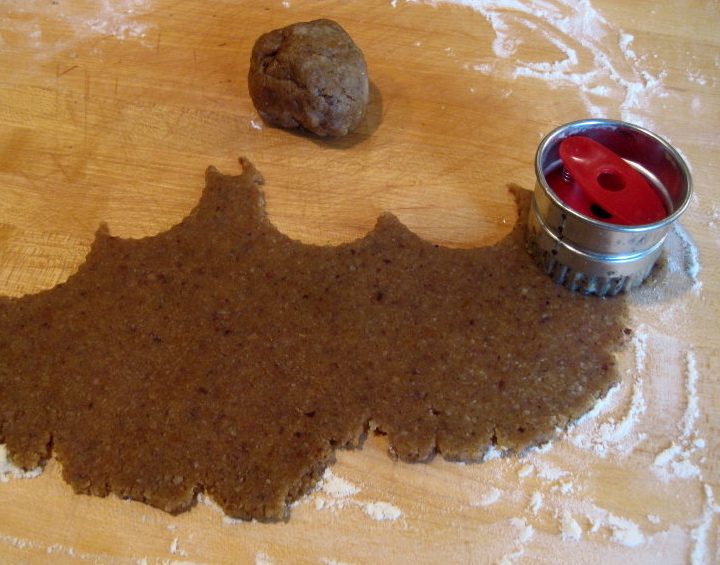
cutting the rolled out dough into cookie shapes

To bake:  Heat oven to 325 degrees.  Cover your cookies sheets with parchment.  Generously flour a work surface.  Roll one ball of the dough 3/16ths inch thick.  Keep the rest chilled and if the working dough gets sticky, re-chill until it is workable.  Cut out as many 2 ½ inch rounds as possible, re-rolling the scraps.

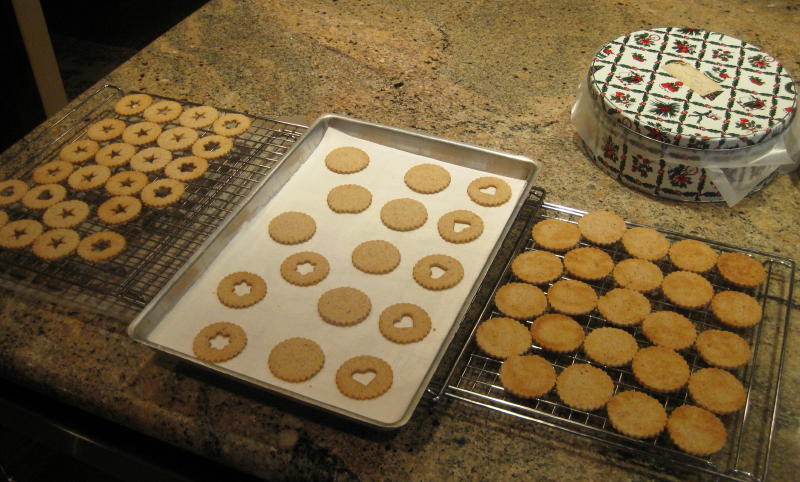
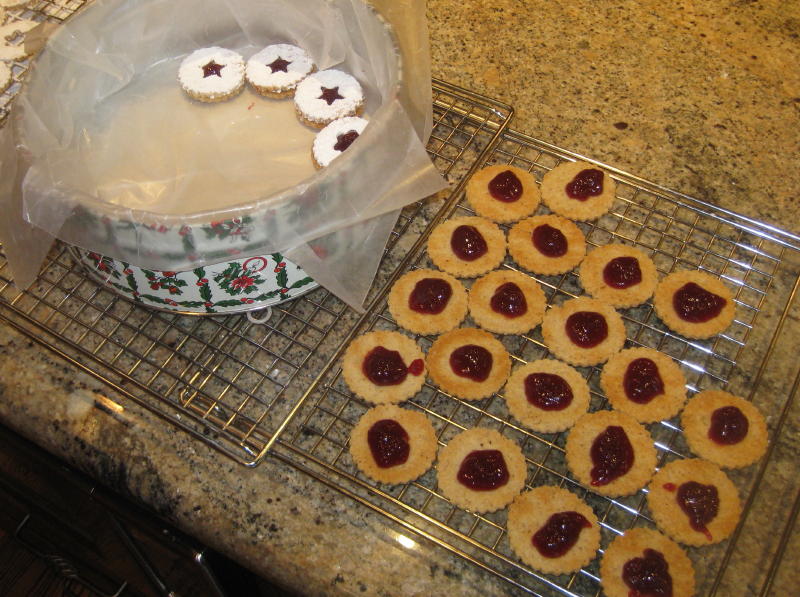
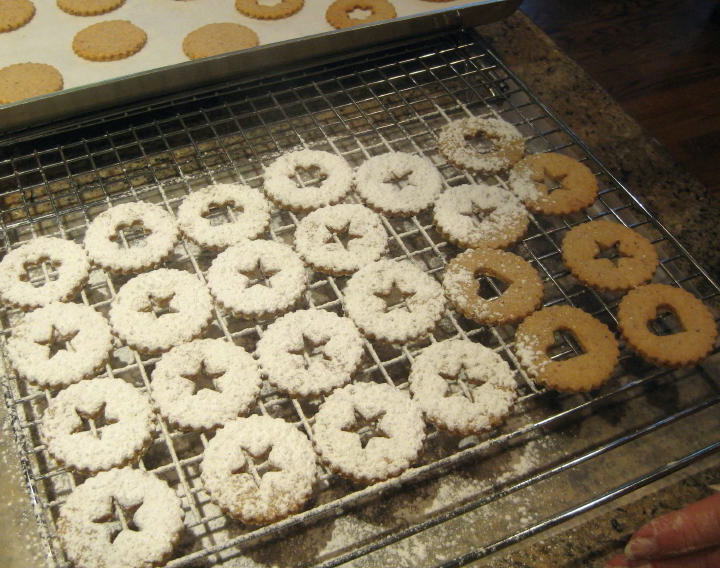
cookie tops and bottoms before assembly with raspberry preserves

Arrange on the cookie sheets about ¾ inch apart. Cut 1¼ inch holes in the center of half the rounds.  Re-roll the center scraps to make more cookies.  Bake until the edges are lightly browned, about 15 minutes.  Let cool on sheets.

the raspberry preserves are spread on flat cookie bottoms

To assemble:  Spread a heaping ½ teaspoon of preserves on the undersides of the whole cookie rounds.  Top with the rounds with the center cut-outs, bottom side against the preserves.  Before serving, dust cookies with confectioners’ sugar.

you can dust the tops with powdered sugar before placing them on top of the preserves

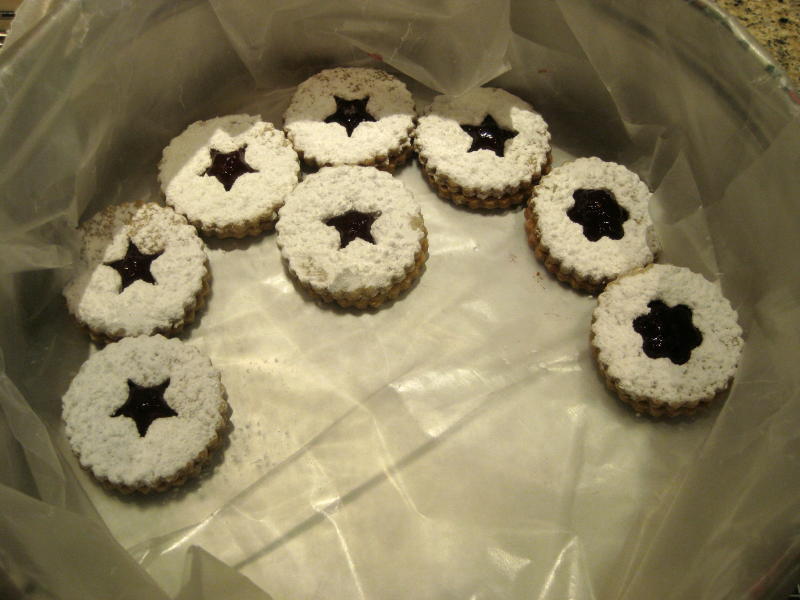
store the cookies in tins layered in wax paper to avoid crumbling and retain flavors

Posted in Uncategorized | Tagged | 2 Comments

Ausstecherle — Classic German Butter Cookies

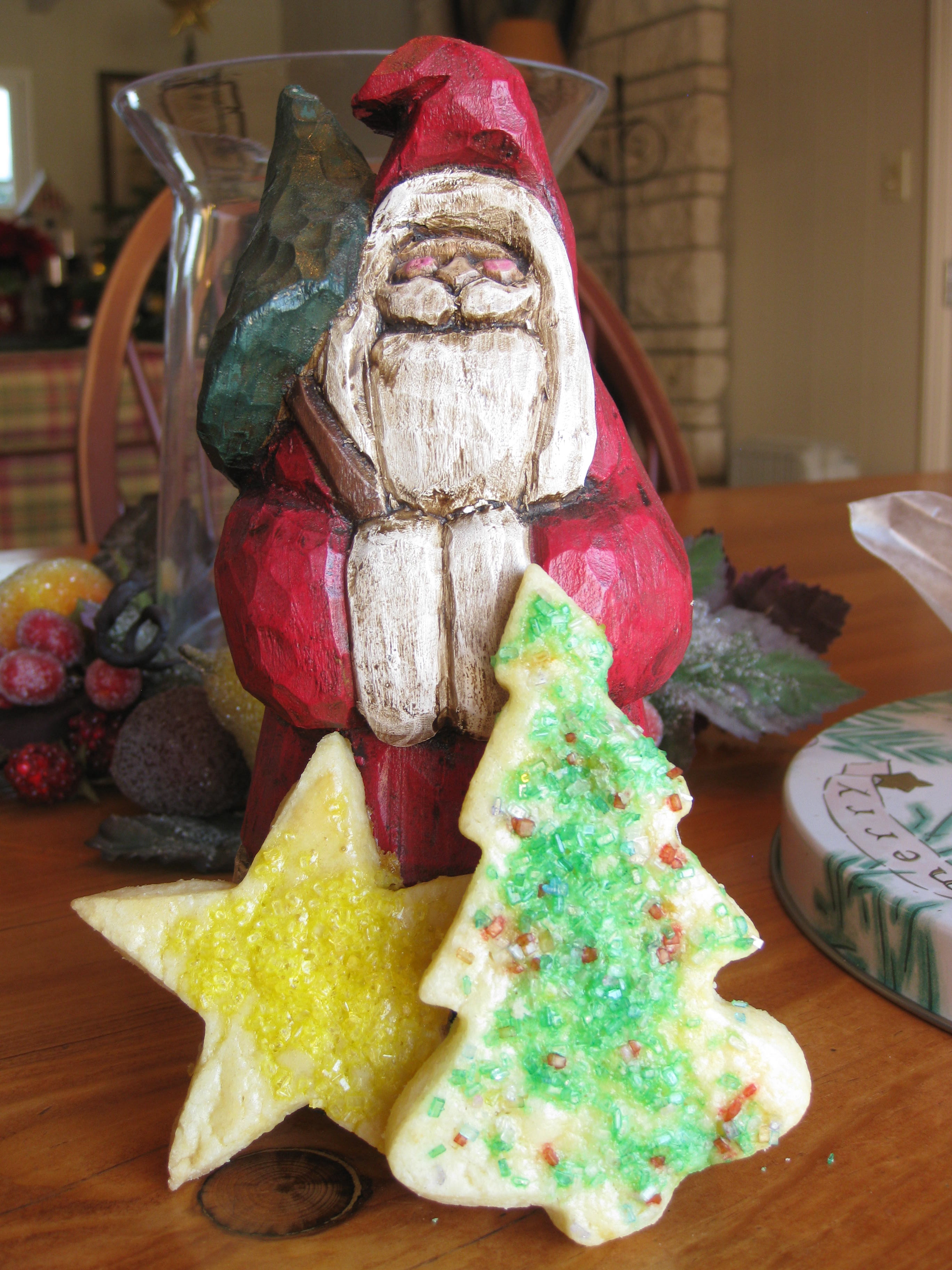
Butter cookies even Santa could love!

This recipe is based on handwritten notes and memories; it is my grandmother’s recipe handed down to my mother.  The German name is colloquial and describes the process of making the cookies.

Translated, Ausstecherle means, “cut out of” or “unplugged.”  “Aus” mean out and “stechen” means to place or put.  The “erle” at the end means “little ones.”

So, Ausstecherle translated from German means “little cut-outs.”  I guess associating the butter cookie to the name comes from usage and tradition.  My mother was under the impression that this term was used merely by her mother at home, and was quite surprised to learn that when I searched for Ausstecherle on the Internet, I found other recipes for traditional German butter cookies.

Butter cookies are, of course, made with loads of butter, sugar and eggs, a classic combination that produces a soft, chewy, richly flavored cookie.  My mother used to decorate these cookies with lightly beaten egg white brushed on top, sprinkled with sugary chopped nuts.  You can also brush them with lightly beaten egg or egg yolk, and then sprinkle the cookies with tinted sugars.  Decorated either way, these cookies are always a cheerful and welcome addition to the holidays.

“You should make your grandmother’s recipe,” my mother suggested.  Hmmm, OK, why not?  I agreed to give it a try.  Ruth made Ausstecherle for my brother and me when we were wee ones – even before she made her first batch of Lebkuchen.  I am happy to report that my family is consuming my Ausstecherle at a satisfyingly rapid rate.  My grandmother Voellm’s original recipe is a big hit, even today.

The recipe offered here makes about 50 to 60 cookies, depending on the size of the cookie cut outs used.  The amount of dough produced by this recipe filled up the bowl of my standing mixer, with flying flour making somewhat of a mess on the counter, and I finished combining all the ingredients by hand with a wooden spoon.  You can always halve the ingredients, making a more manageable amount of dough to handle.  But be ready for these cookies to fly out of the tin, much like the flour escaping the rotating mixing bowl – they are tasty in a good old-fashioned way.

Watch them fly out of the tin....

Recipe for Ausstecherle

Makes 50 to 60 cookies, depending cookie cutter sizes.  Active time:  To mix dough, about 20 minutes; each sheet takes about 13 to 15 minutes in the oven.

Ingredients:

¾ pound butter (three sticks), softened
3 cups sugar
8 egg yolks
2 teaspoons vanilla extract
4 ½ cups flour
1 teaspoon baking powder
1 teaspoon salt

Decoration: 1 or 2 eggs (using whites and/or yolks); tinted sugars; or, finely chopped nuts mixed with sugar

Preparation:

Sift together flour, baking powder and salt in a small bowl and set aside.  In a large bowl of a standing mixer, cream the butter until lighter in color.  Add the sugar; mix butter and sugar until well combined.  Add egg yolks and mix until combined.  Slowly add dry ingredients.  Mix on low speed until most of the flour is integrated. Do not over mix.  You may need to mix in the last additions of flour by hand using a wooden spoon.

Gather dough into a ball and divide into 4 disks. Refrigerate for about 30 minutes to an hour.  You can refrigerate dough longer or even overnight, but the dough will need to come back almost to room temperature to roll out.

Preheat oven to 325 degrees.  Roll out dough to about 3/8ths of an inch.  Re-combine and re-roll scraps.

Place cut out cookies on unbuttered cookie sheets.  Decorate cookies: (1) Brush tops of cookies with lightly beaten whole egg or egg yolk and sprinkle with tinted sugar.  Or (2) brush tops with lightly beaten egg whites mixed with a little sugar, and using a teaspoon, drop the finely chopped nuts, pre-mixed with a little sugar, onto center of cookies.

Bake for 13 to 15 minutes, depending on cookie sizes.  Edges should slightly golden but not brown.  Let cool for about 5 minutes on baking pan and the transfer to rack to cool completely.  Store in airtight container.

Posted in Uncategorized | Tagged , | 2 Comments

Date Pecan Bars — Or, Apricot Walnut Bars? Your Choice.

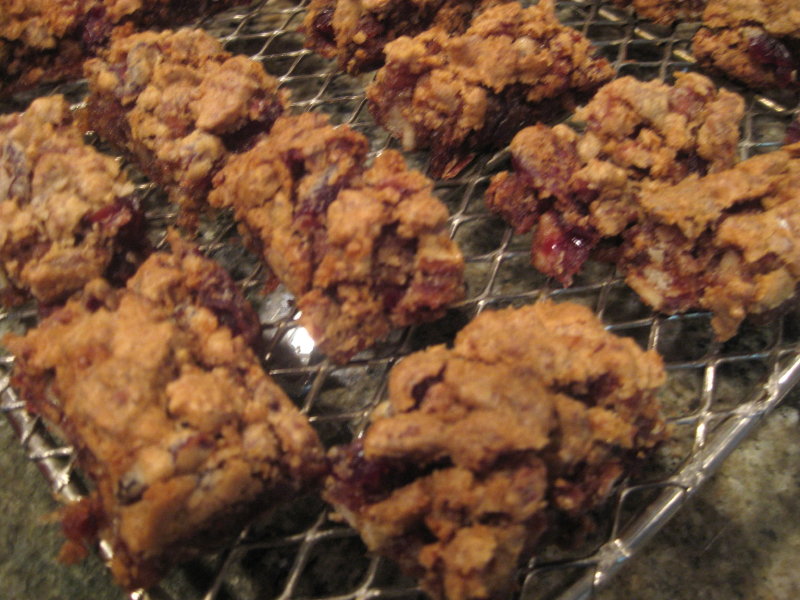
Date Pecan Bars with Dried Cranberries

My mother Ruth has been making these naturally moist and delicious date and pecan bars for decades.  Although not based on a classic German recipe, these cookies fit quite nicely on our family’s traditional Christmas cookie platter.  The recipe is easy to make, and very versatile.  These days, you can even buy dates and nuts pre-chopped, which really trims your preparation time.

Ingredients can be swapped out very easily, too.  The original 1956 recipe calls for ¼ pound of candied cherries.  My mother now uses the healthier ingredient of dried cranberries instead.  My mother’s friend, Beatrice Chang, recently told her she successfully used this recipe substituting walnuts for the pecans, and dried apricots for the dates.

These cookie bars are chock full of dried fruit and nuts; indeed, there is just enough batter to hold the key ingredients together.  My mother says this old Gourmet cookie recipe is different from most others, and that she has never found another quite like it.  I guess you could say it is an old recipe with a new attitude!

Recipe for Date and Pecan Bars, or Apricot and Walnut Bars

Adapted from Gourmet Cookbook (1956, 8th edition)

Note:  The pecans can be replaced with walnuts; the dates can be replaced with dried apricots; the candied cherries can be replaced with dried cranberries (and the dried cranberries don’t need to be chopped).  If you are chopping your own dates, use a little sugar to keep the dates from sticking to the knife blade and to each other.

Active time: If you are chopping your own ingredients, it could take about an hour or a little more, including baking time.

Ingredients:

2 eggs, lightly beaten
1 cup granulated sugar
2 cups chopped pecans
1 pound dates, pitted and chopped
¼ pound candied cherries, cut into small pieces
1 teaspoon vanilla
½ cup flour
1 teaspoon baking powder

Preparation:

Preheat oven to 350 degrees.

Sift together the flour and the baking powder, set aside.  In a large bowl, by hand using a wire whisk, cream together the eggs and the sugar.  Using a flat wooden spoon, add the pecans, dates, candied cherries, and vanilla.  Add the dry ingredients and mix until combined.  Spread the batter in an unbuttered shallow rimmed baking pan (about 10 x 15 inch size, or jelly roll pan size) and bake for 30 minutes.

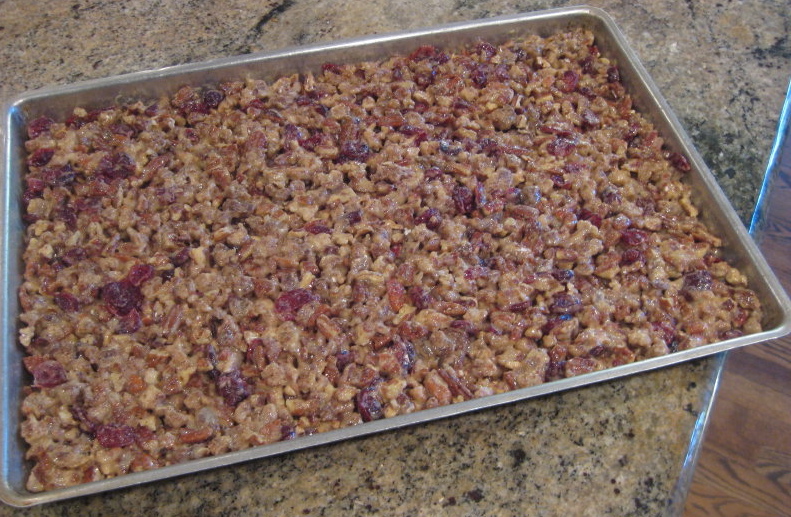
date pecan cake, just out of the oven, before cutting into bars

Cut cake into small bars while still warm, about 1.5 x 2.5 inches in size, or a size to your liking. Cool bars completely on a rack.  Store in an airtight container or tin, layered with wax paper for maximum freshness.

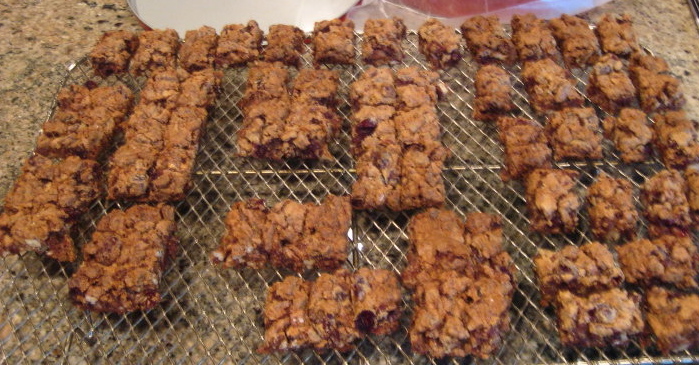
cut cookie bars cooling on a rack -- naturally moist and delicious!

Posted in Uncategorized | Tagged , , , , | Leave a comment

Zimtsterne — Ready to Steal the Show

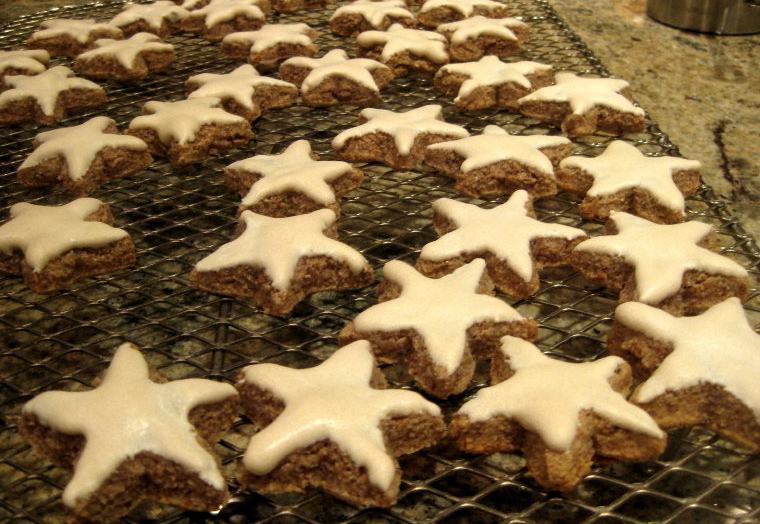
Ruth's Zimtsterne, just out of the oven

Zimtsterne have the potential to steal the cookie show – they are stars, after all – but in my experience, they seem content to sit back, enjoy the good company of all the glamorous and glitzy cookies surrounding them on the holiday platter, and wait to be discovered.  When you finally pick one up and take a bite, you’ll soon realize that Zimtsterne are brilliant constellations of spice and nuttiness, with a delightful meringue-like texture underneath a layer of sweet icing.  Then there is no going back.  You will be a devoted fan of this additive little cinnamon star cookie for life.

Zimtsterne are by all accounts a classic German Christmas cookie.  My father Paul says that when he was a boy, he remembers his German-born mother, Emilie Koch, making Zimtsterne during the Christmas season.  My mother Ruth also recalls that when she was growing up, Zimsterne were always a part of the regular repertoire of goodies consumed during the holidays.  So, when Ruth found a Mimi Sheraton New York Times recipe for Zimtsterne in 1977, she gave it a try, and has been making them for her family and friends pretty much every year since then.

Making Zimsterne is not complicated, but the dough can be just a bit tricky to work with. The dough has no flour.  This is a good thing for those looking for a gluten free recipe.  However, no flour also means the dough can get sticky, and my mother’s experience with making these cookies enables her to recommend the following tips:

To make the dough easier to work with, add more almond flour, a little at a time, to sticky dough, until you can roll it out. When cutting out the cookie from the rolled dough, have a little sharp knife on hand to scrape any extra dough from the cookie cutter so you can keep re-using it.  Use the extra-fine sugar for dusting the board and the cookie cutter.  In addition, avoid making these cookies in overcast or rainy weather, since the egg whites will not peak and the cookies will be sodden.

My recommendation?  Keep your cherished Zimtsterne out of the limelight.  If you have the chance to pluck one of these pleasantly chewy cookies from the dessert platter being passed around during a holiday gathering, try not to publicly confess your adoration for them.  That way, there may be a few left for you to plunder when the platter, at long last, comes around a second time.

Recipe for Zimtsterne – Cinnamon Stars

Adapted from November 30, 1977 New York Times recipe, by Mimi Sheraton
Makes about 72 (six dozen) cookies
Active time: About 1 hour, with 20 minute bake time
Notes: Avoid making this recipe when it is raining or heavily overcast; egg whites will be dense and cookies will be sodden in texture.  Also, for best flavor, use top quality ground cinnamon, such as the extra fancy Vietnamese available at Penzey’s Spices.

Ingredients:

3 egg whites
1 ¼ cup granulated sugar
3 teaspoons cinnamon
1 ½ to 2 cups (as needed) unblanched almonds, finely ground
1 teaspoon brandy (or vanilla extract)
Extra fine granulated sugar for pastry board

Preparation:

Preheat oven to 300 degrees.

Butter one or two large cookie sheets.

Using a standing mixer, or an electric hand mixer, beat the egg whites in a bowl, and as they begin to foam and stiffen, gradually beat in the sugar. Continue to beat until whites form stiff peaks that retain the mark of a knife blade.  Set aside half a cup of the beaten egg whites.

Sprinkle remaining whites with cinnamon, one and a half cups of almonds, and brandy or vanilla extract.

Stir together gently but thoroughly, by hand or on low speed. Mixture should be thick and fairly solid. Add more almonds if the dough is too sticky to be rolled.

Sprinkle pastry board (or smooth counter top) with extra fine sugar and roll out dough to 1/4 inch thickness. Cut into star shapes using a small sized cookie cutter.

rolled out dough getting cut into star shapes; board is dusted with extra-fine sugar

Arrange the cookies on the buttered cookie sheets and brush the top of each cookie with a little of the reserved egg whites. Bake in preheated oven about 20 minutes or until golden. Allow cookies to cool and carefully transfer them with a spatula to rack to cool completely. Store in airtight container or tin, using wax paper to layer cookies.

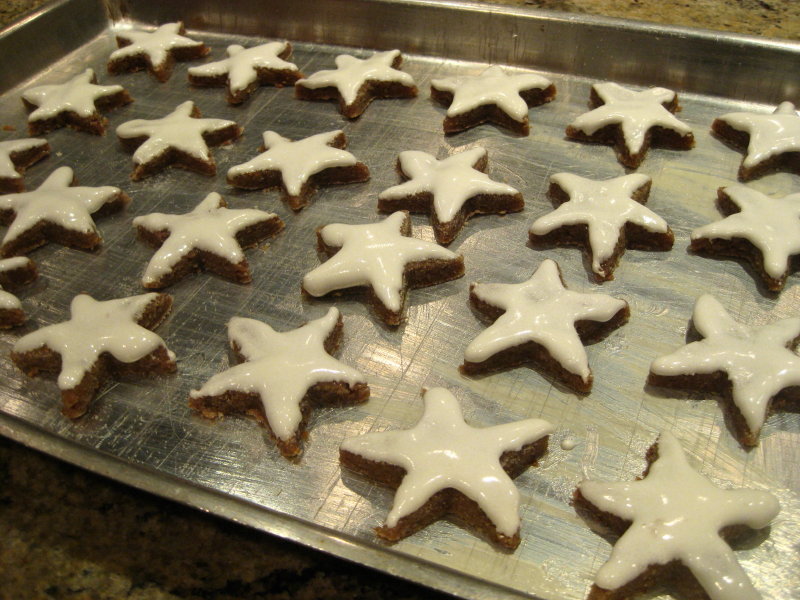
cookies brushed with beaten egg whites and ready for the 300 degree oven on buttered sheets

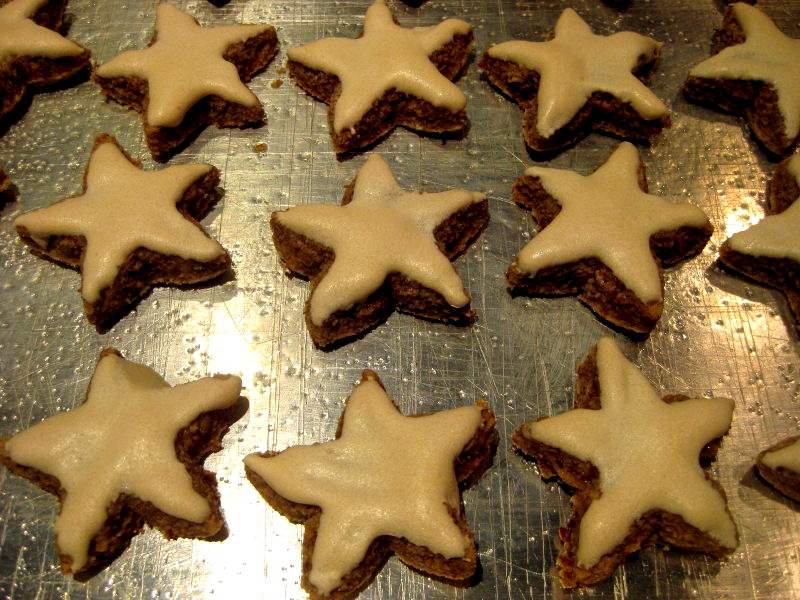
Zimtsterne cookies, just out of the oven, cooling before transfer to racks

Posted in Uncategorized | Tagged , , | Leave a comment

Springerle — Incredible Edible Folk Art

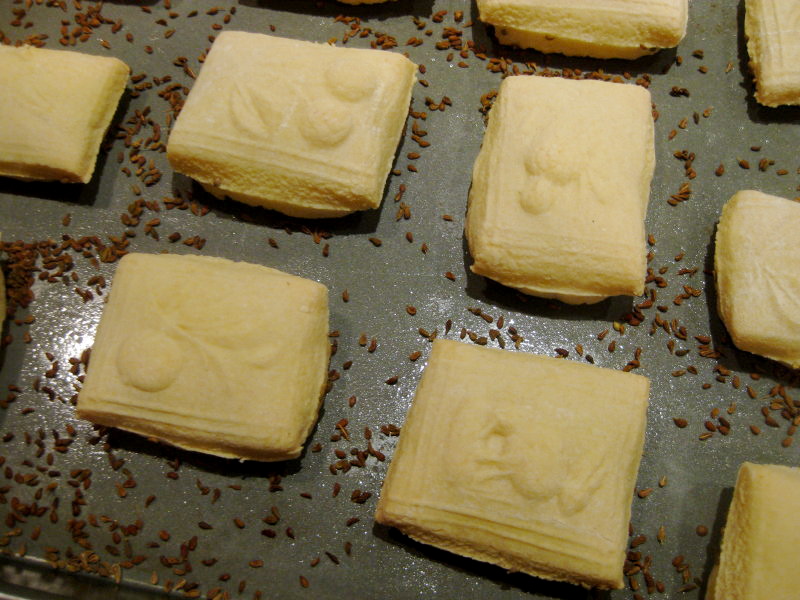
Springerle, just out of the oven

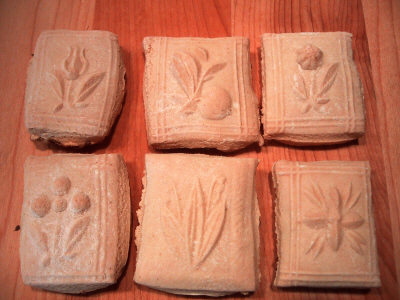
I am totally infatuated with my mother’s anise Springerle, a biscuit-like cookie that looks like it was created in an enchanted forest by incredibly talented kitchen elves.  These cookies have embossed folk art designs on top, whole anise seeds embedded underneath, a crunchy layer on the outside, and a springy texture in the middle.  How is this all possible for one little cookie?  Even the name, Springerle, is an endearingly cute word that rolls off your tongue like a sweet piece of licorice.

Not surprisingly, Springerle cookies are full of history and culture.  Springerle have been exchanged as gifts among families in the Bavarian parts of Europe for centuries.  Today, people collect the intricately carved wood Springerle molds as antiques.  Most Internet sources say that Springerle means “little knight” or “jumping horse.”  To me, the cookies spring from a mold, hence, they are Springerle.  It can’t be more complicated than that.

My mother has vivid childhood memories of making Springerle with her mother, Elizabeth Damm, who was born in Austria and came to this country after World War I.  My grandmother must have made Spingerle in the old country, my mother says, because she recalls making them by hand with her mother every Christmas season.

When my mother and my grandmother made Springerle together, it was before the era of standing mixers, and they sat, facing each other on kitchen chairs, with a large bowl balanced on their knees between them, simultaneously beating by hand the eggs and sugar for up to 30 minutes, until they were the proper consistency.

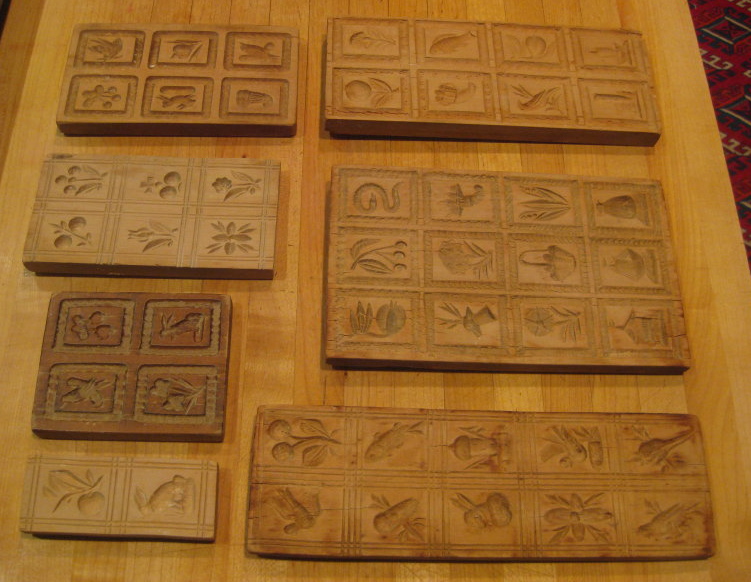
A collection of Springerle molds – my mother calls them brett, or boards – are displayed in her modern kitchen, and she swears that a few of those boards belonged to her mother. Ruth bought her other boards at antique shows and a few during a trip to Bavaria.

Ruth's wood carved Springerle Brett

The recipe my mother uses is from the 1956 8th edition of the first Gourmet cookbook, first published in 1950.  It is not a complicated recipe, but the cookies, after being embossed, need to sit out at room temperature overnight before baking.  This drying process will set the design, and give the cookies their trademark crunch.

Springerle are lovely edible heirlooms that are almost too good-looking to eat.  Yet I look forward to devouring them year after year.  Don’t worry if Springerle go slightly stale – they are delicious when dunked in cold milk or hot chocolate, and will keep the holiday spirit going, even after the calendar is turned to the New Year.

Springerle Recipe 

Adapted from Gourmet Cookbook (1956)
Makes 45 to 50 cookies
Active time: about an hour to 90 minutes with bake time; dough needs to set overnight before baking

Ingredients:

4 eggs
2 cups fine granulated sugar
3 ½ cups sifted flour (plus more for rolling out dough)
1 teaspoon baking powder
¼ teaspoon salt
2 tablespoons butter, melted (plus more for buttering baking sheets)
4 to 5 tablespoons anise seeds for sprinkling on the buttered baking sheets

Preparation:

Sift together the flour, baking powder and salt, and set aside. Beat the eggs in an electric mixer until light and fluffy, about 10 minutes. Continue beating for about 6 or 7 minutes more, while gradually adding the sugar.  Add the dry ingredients to the mixture alternatively with the melted butter. Add a little more flour if the dough is too sticky to roll out.

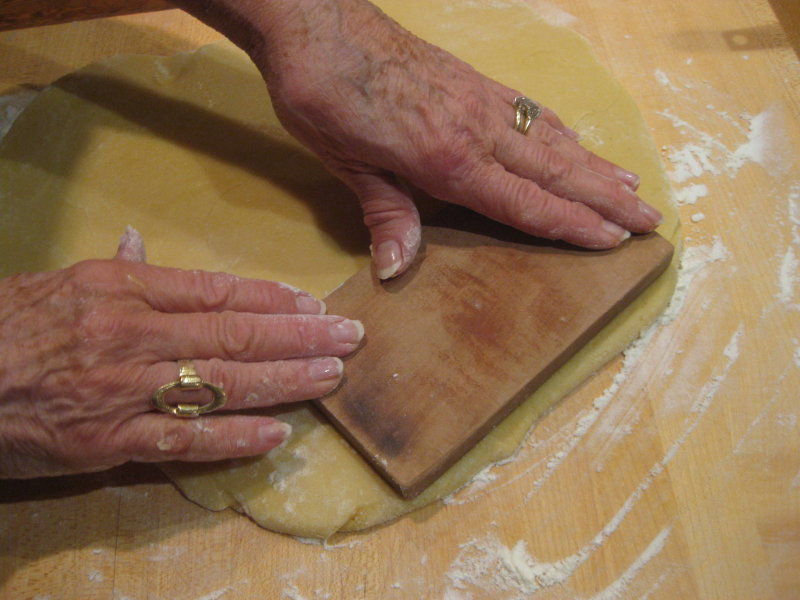
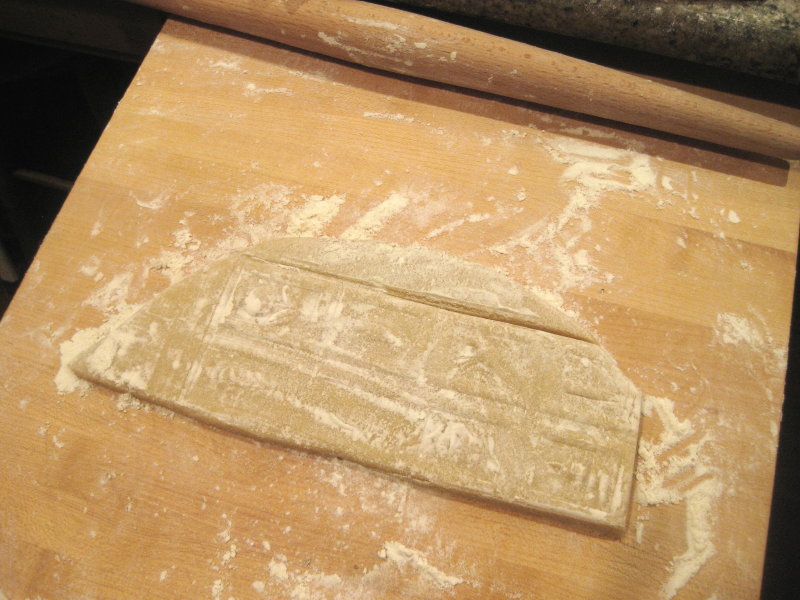
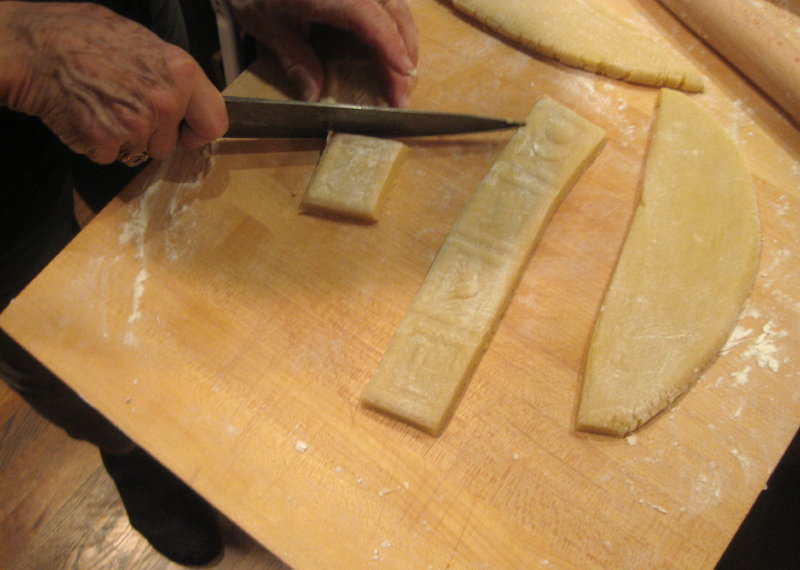
Gather the dough into a ball and place on a floured work surface. Using a floured rolling pin, roll out the dough lightly to ¼ to ½ inch thick. Use a Springerle board or Springerle-embossed rolling pin to press shapes onto the dough. Cut the cookies apart following the designs, trim the edges, and re-roll the excess scraps.

pressing the board onto the rolled dough to make the designs

rolled out dough after getting embossed

trim the cookies and re-roll the scraps

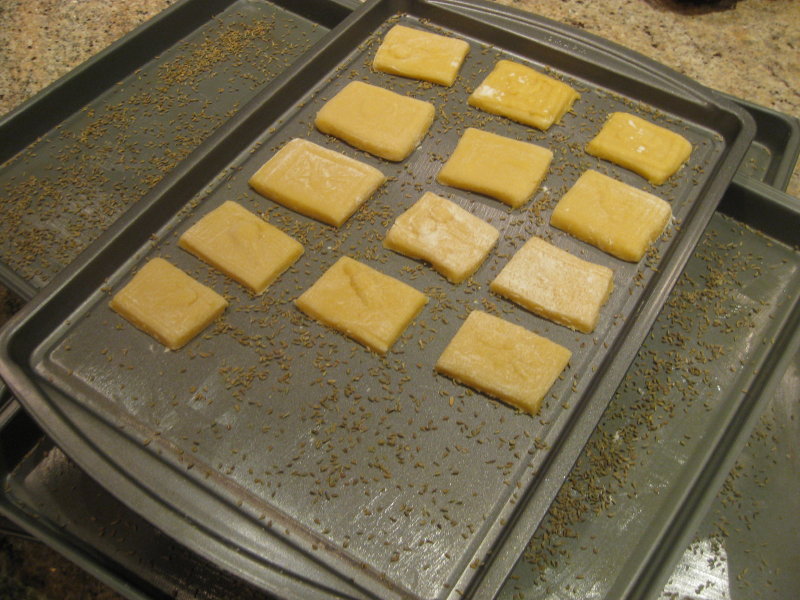
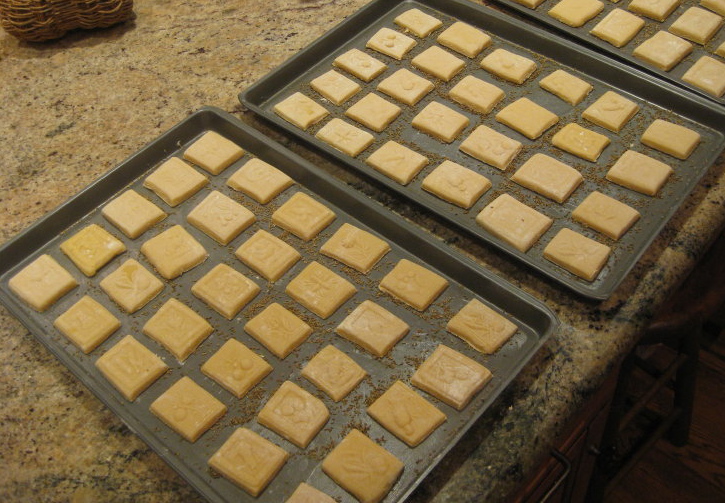
Sprinkle the buttered baking pans with the anise seeds. Place the cookies on the pans and let them sit out at room temperature overnight to set the designs.

place the trimmed cookies on the buttered baking pans, sprinkled with anise seeds

let the cookies sit out overnight before baking to allow the design to set

Preheat oven to 350 degrees.  Place one sheet of cookies at a time in the middle to lower third of the oven.  Bake at 350 degrees for 5 minutes, and then lower the temperature to 325 degrees and bake for about 10 minutes more.  Do not allow the cookies to take on color, only the bottoms should turn a light golden color.  Transfer the cookies to cooling racks; allow cookies to cool and dry completely before storing.  Use airtight containers or tins, layering the cookies between wax paper.  Add the leftover anise seeds to the tins for added flavor.

Springerle look almost too good to eat....

Posted in Cookies, German Christmas | Tagged | 1 Comment

Haselnuss Bällchen — A Winning Combination

neat rows of just baked chocolate hazelnut balls

The winning combination of chocolate and hazelnuts is the focal point of my mother’s melt-in-your-mouth Haselnuss Bällchen.  Ruth’s bite-size hazelnut balls, based on a December 1978 Gourmet magazine recipe, are deliciously decadent, similar to a nutty chocolate truffle.

My mother has made these cookies during the holidays for over 30 years. They are easy to make, and the festive and uniquely rich flavor of hazelnut is a perfect complement to the variety of other cookies in her Christmas baking portfolio.

There are only four ingredients in this recipe, so look for the best quality chocolate and hazelnut.  Flour is not an ingredient, a plus for those looking for a gluten free cookie.

Recipe for Haselnuss Bällchen

Adapted from December 1978 Gourmet 
Makes about 60 cookie balls
Preparation time: About 1 hour; bake time: 8 minutes

Ingredients:

3½ oz semisweet (or dark) chocolate
¾ stick (6 tablespoons) unsalted butter, softened
1 cup sifted confectioners’ sugar
1¼ cup ground hazelnuts

Preparation:

A note about the hazelnuts (or filberts): Use pre-ground hazelnuts if you can find them; otherwise, lightly toast raw whole hazelnuts, place them in a paper towel or kitchen towel, and rub off the skins. Grind the hazelnuts in a food processor until they are fine, but do not over-process to a paste.

Melt the chocolate, using a metal bowl set over a saucepan with simmering hot water, or using a microwave-proof bowl and low heat. Watch the chocolate, so it does not burn or overheat.  Let the chocolate cool.

In a bowl beat the butter with the confectioners’ sugar until the mixture is fluffy. (Use a standing mixer, an electric hand-mixer, or mix by hand with a metal whisk.)  Stir in the melted, cooled chocolate and beat the mixture until it is very creamy and smooth. Stir in the ground hazelnuts, form the mixture into a ball, and chill it for at least 30 minutes, wrapped in wax paper or plastic wrap.

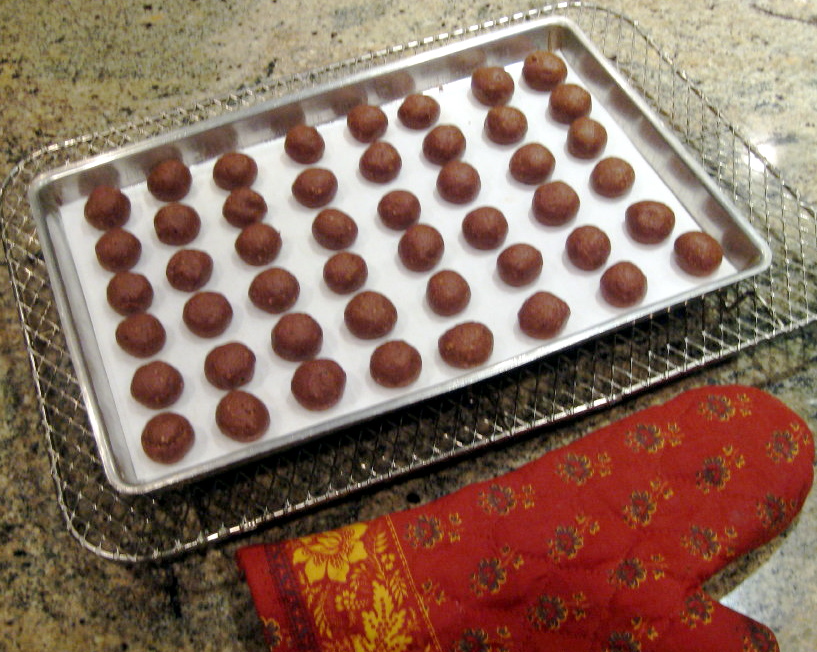
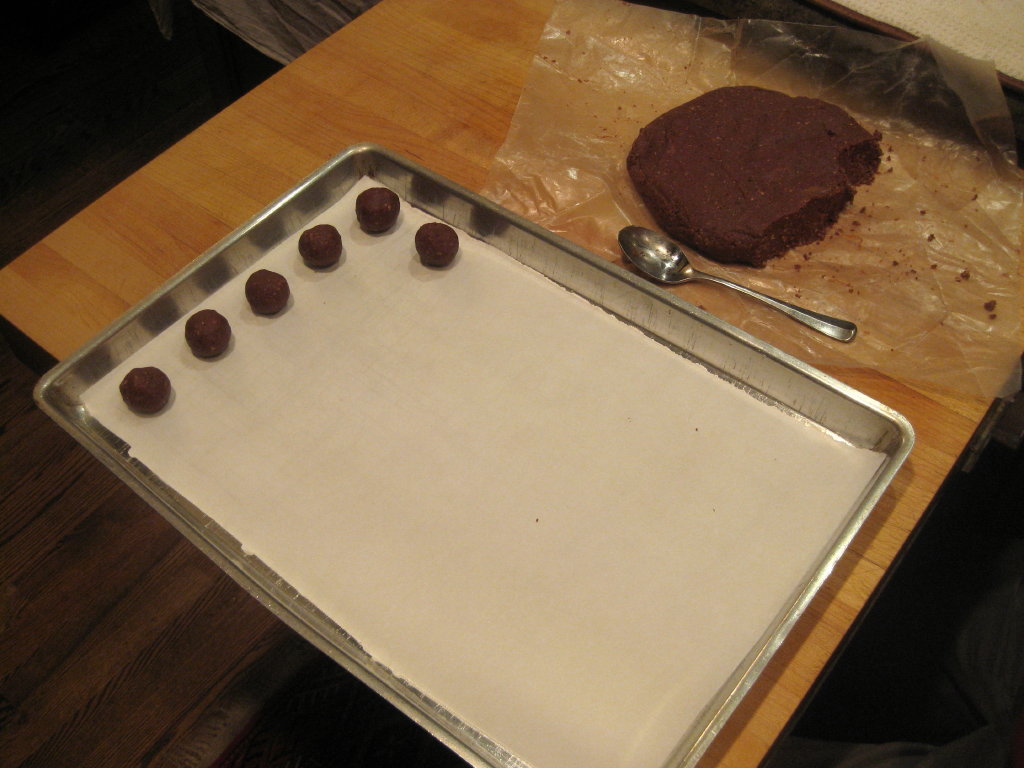
use a teaspoon-full of dough to make the hazelnut balls; use parchment paper for baking

Preheat oven to 300 degrees. Pinch off 1 teaspoon of the dough at a time, rolling it in your palms to form a ball. Arrange the balls on baking sheets lined with parchment paper, and bake them for 8 minutes, or until they have lost their gloss. Let the balls cool on the baking sheets and store them in an airtight container.

the cookies are done in about 8 minutes; let them cool on the baking pan

Posted in Uncategorized | 7 Comments