
Christmas in the Steck household doesn’t officially get started until the first batch of Lebkuchen comes out of the oven. My mother Ruth has been making this traditional German holiday treat since I can remember, and recently kicked off her family’s 2011 holiday season by baking a triple batch. Age does not seem to slow my mother down. She is an inspiration, in many ways.
My parents grew up with holiday traditions rooted in German and Austrian cultures. My mother’s father, Herman Voellm, was born in southern Germany, as were both of my father’s parents. My mother’s mother was born in Austria, near the Polish border. All my grandparents immigrated to the States after World War I, landing in the New York and Philadelphia metropolitan areas. My parents met as young adults at a family reunion picnic, as the story goes, because my grandfathers knew each other as boys living in the same small town of Moehringen, near Stuttgart, Germany.
When Ruth was growing up in the Philadelphia area, Lebkuchen was a special treat brought into her home during the holidays, but she never found a recipe or baked them herself until she got married in the mid-fifties. While they were newlyweds, my father was in the U.S. Air Force, stationed in England, and he bought a copy of the original edition Gourmet cookbook, first published in 1950. He brought the cookbook home for his new wife, and when my mother saw the standard Lebkuchen recipe inside, she decided to give it a try. Ruth has been using this original 1950 recipe since then, tweaking it over the years to suit a modern kitchen.
Lebkuchen is a pleasantly soft and chewy gingerbread type of cookie, although ground ginger is not an ingredient in Ruth’s recipe. The complex flavor is derived from such ingredients as honey, ground almonds, cinnamon, cardamom, nutmeg and cloves. The warm, just out of the oven cookies are iced and decorated with candied cherries or sliced almonds. The cookies last for weeks, long after the holidays are over.
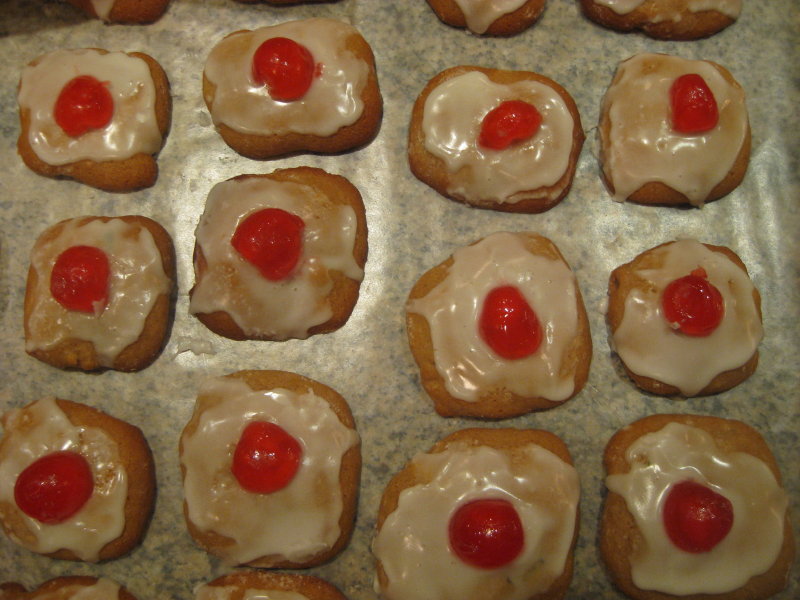
the finished product
To me, Lebkuchen are my mother’s “signature” holiday cookie. If I had to choose one cookie for the holidays, that would be it. My brother Paul agrees — no surprise there. He cleverly compares our mother’s Lebkuchen to the fountain of youth: “One aromatic and existential bite refreshes the memories and releases the timeless spirit of Christmas,” he teases in an email to me. Too much? Not really. It’s all true.
It’s not just me and my brother who are passionate about Lebkuchen. They have been a popular holiday choice for centuries, baked in German monasteries since the 1200s. The city of Nürnberg is today famous for its commercial Lebkuchen production, and it is believed the cookies were first called Lebkuchen there in 1409.
If Lebkuchen are the starting point for the holidays in the Steck household, then the magic of Christmas, with all its family memories, is sure to come soon … along with plenty more cookies.
Lebkuchen Recipe
This recipe is based upon a Gourmet Cookbook recipe, originally published in 1950. The recipe makes one batch or about six dozen cookies. Once combined, the dough needs to sit before baking for 24 hours and up to 72 hours at room temperature to ripen and mellow. Citron, a candied fruit, is usually available during the winter holidays at major grocery stores. Cardamom seeds are also usually available at major grocery stores; ground cardamom can also be used but the crushed seeds give a much better flavor. The ground almonds can be bought pre-ground, or you can buy slivered blanched almonds and grind them in a food processor with a little white sugar; do not over process to a paste. Lebkuchen keep, tightly stored at room temperature, for weeks and even months. The baked cookies taste best a few days after baking, allowing all the flavors to meld together.
Ingredients:
For the dough:
1 cup honey
¾ cup packed brown sugar
1 tablespoon lemon juice
1 teaspoon lemon zest
1 egg
2 ½ cups sifted flour
½ teaspoon baking soda
½ teaspoon ground nutmeg
½ teaspoon ground cloves
1 teaspoon cinnamon
½ teaspoon crushed cardamom seeds
1/3 cup chopped citron (candied)
1/3 cup ground blanched almonds
For the icing (approximate amounts):
1 ¼ to 1 ½ cups confectioners sugar
2 teaspoons or more lemon juice
2 tablespoons heavy cream
For decoration: Use candied fruits or nuts to top the icing. Halved candied cherries are both festive and colorful.
Directions:
In a small bowl sift together the flour, baking soda, nutmeg, cloves and cinnamon, and set aside. Measure and set aside the cardamom seeds, citron and ground almonds. (The cardamom can be crushed using a mortar and pestle or by placing the seeds in a Baggie and pounding them with a small hammer or metal pounder.)
Scald and cool the honey (liquefy in a saucepan or set in a bowl in a microwave oven at medium). Using a large mixing bowl, mix together (with large spoon or spatula, no standing mixer required) the honey, brown sugar, lemon juice, and the lemon zest. Add the egg, already beaten, to the bowl, beating again it to combine. Gradually add the flour mixture, blending until combined. Add the crushed cardamom, seeds, chopped citron, and ground almonds and mix until combined. Cover the bowl and let stand at room temperature for 24 to 72 hours before baking.
When ready to bake, pre-heat the oven to 400 degrees. Butter the cookie sheets.
Prepare the icing: Mix confectioners sugar, lemon and cream with a fork or a small whisk in a bowl until smooth and free of sugar lumps. Icing should be opaque when spread on the warm cookie. Add more sugar as needed.
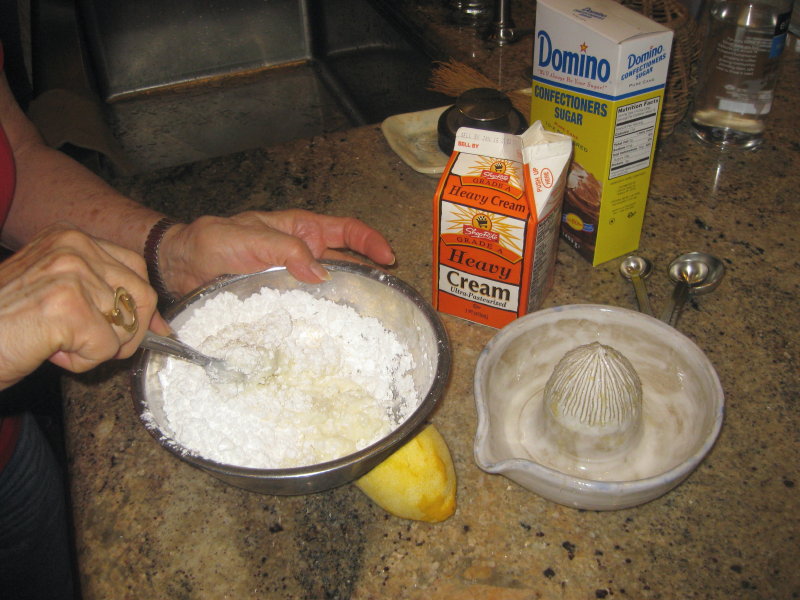
making the icing
Roll the dough, using about 2 cups at a time, on a floured work surface, into a sheet ¼ to ½ inch thick. Use a floured rolling pin (or your floured hands) to press the dough into a workable disk. If the dough is too soft, stir in a small amount of flour, making it easier to work with.
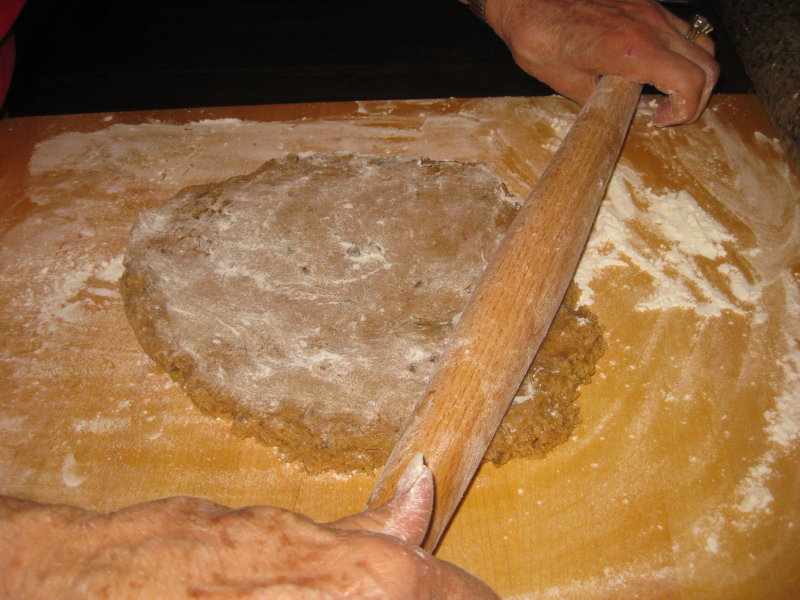
rolling out the dough on a floured surface
Cut the dough into bars or squares using a long, sharp knife, or cut the dough using round or heart shaped cookie cutters. Flour the cutting utensils. Re-mix the scraps into the bowl, so they are not wasted. Cookies will round out and puff up while baking.
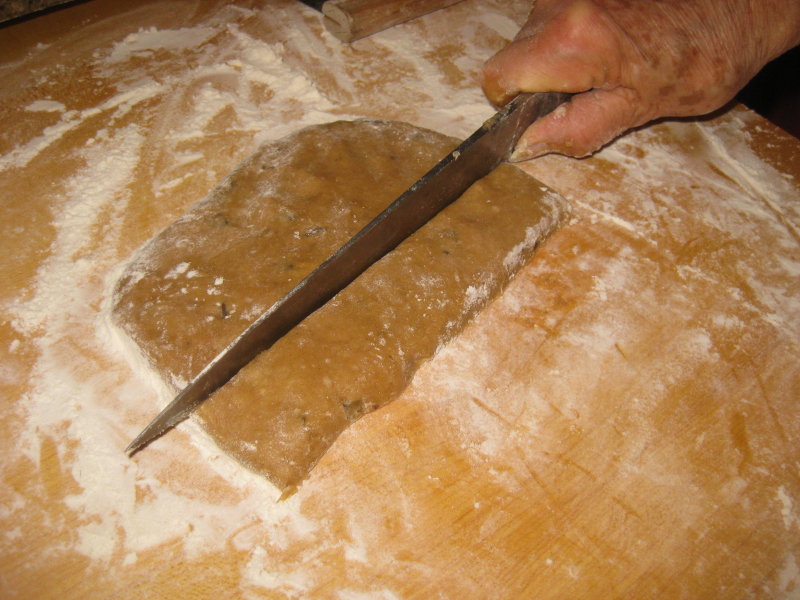
cutting the dough into cookie-sized squares
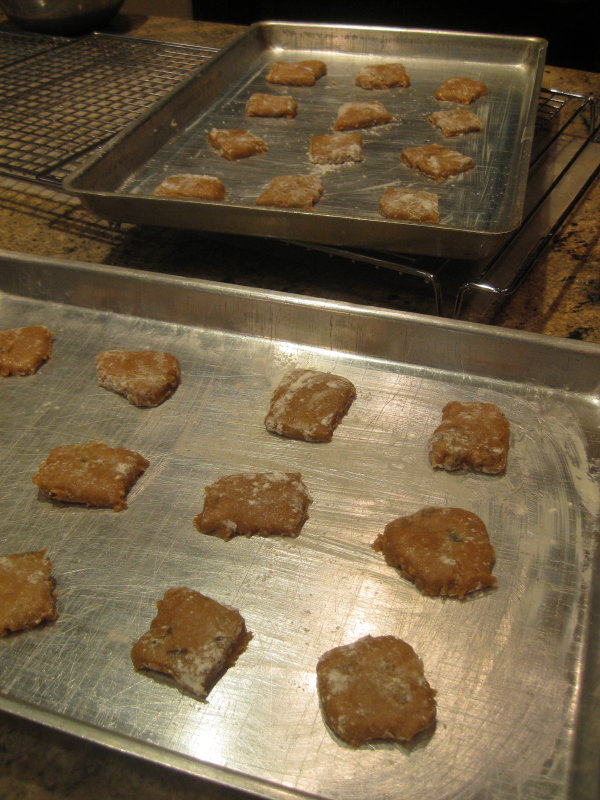
ready to go into the oven
Bake the cookies until very lightly colored, about 7 to 8 minutes, depending on how many cookies and cookie sheets are in the oven at one time. Transfer the cookies immediately to cooling racks. Ice and decorate the cookies while they are still warm. Optional: Place sheets of wax paper under cooling racks to catch the icing drips, making clean up easier.
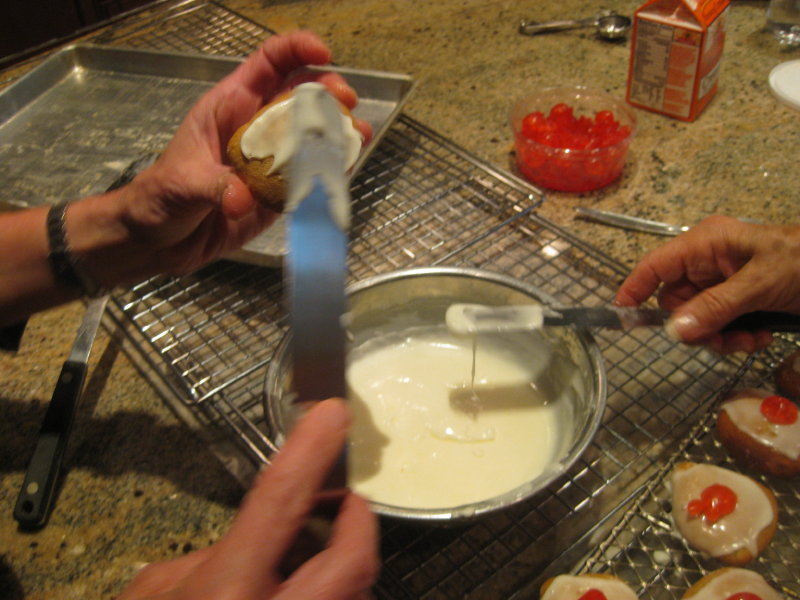
icing the warm cookies
Allow the cookies to cool and the icing to dry completely before storing in tins or other airtight containers. To maximize freshness, line stored layers of cookies with wax paper. The texture and taste of Lebkuchen improve with age. Wait a few days after baking to consume, if possible. Enjoy — morning, noon and night!
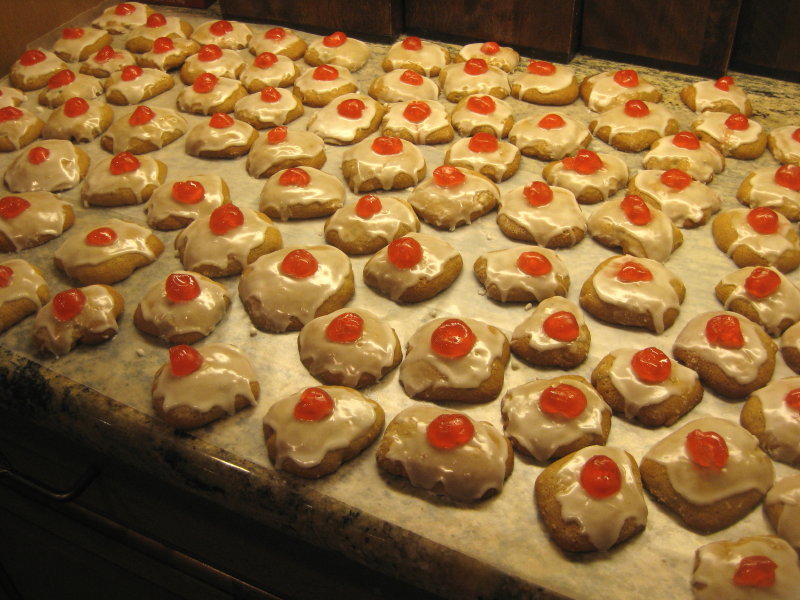
let the cookies cool and dry completely before packing in tins


 Ruth's Christmas Cookies
Thank you for the lovey recipe and pictures. I lived in Germany as a young child, my father was in the military, we moved home just before I started school. Our oldest daughter is 11, last week she came home from school saying she needed to produce a report on Christmas in Germany. It brought back a lot of memories for me, one of which was lepkuchen. We ended up making modifications to a tried and true gingerbread cookie recipe, as I could not find candied citrus rinds or cardamom seeds anywhere. However after a little research I’ve located a place to buy it and now I want to make real lepkuchen for Christmas Eve.
Thank you for your interesting comments and I hope your lebkuchen turn out to be delicious!