Viennese Vanilla Crescents — The Power and Purity of Vanilla

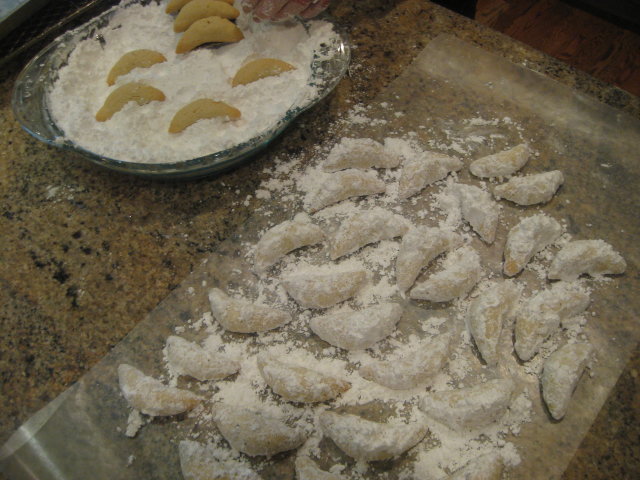
Ruth's Vanilla Crescents, getting dredged in vanilla confectioners' sugar

Lebkuchen and Stollen feature complex flavors from a variety of spices and a range of ingredients.  For Viennese Vanilla Crescents, however, it is all about the power and purity of vanilla. These cookies also have a melt in your mouth texture derived from ground blanched almonds and top quality European style butter.  There are only six ingredients for Vanilla Crescents, so be sure to use the very best quality vanilla bean, butter and almonds.

Vanilla Crescents have been part of my mother’s holiday baking for decades.  Her recipe is based on an old House & Garden recipe that she can no longer find.  She simplified and re-typed the recipe for use with a food processor instead of a standing mixer. Ruth uses Plugra European Style butter, when she can find it.  She buys vanilla bean from the Penzey’s Spices catalog, or at the new Penzey’s store in Summit NJ.

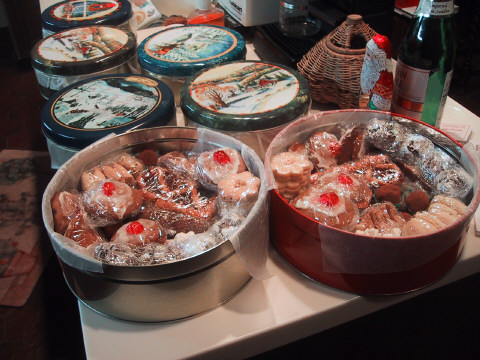
My brother’s family makes such a fuss over my mother’s Vanilla Crescents that they get a whole tin of them, loaded up with a white-out of vanilla sugar.  In my brother Paul’s words: “The main attribute of the Vanilla Crescent is its simplicity, and great texture. It is almost a palate cleanser, with its not too sweet, but pure combination of vanilla cookie and finely ground almonds, all synthesized into a unique holiday treat.”  My lovely niece Julia loves the cookies too, and admits she has a little holiday habit of pinching off the extra vanilla sugar from the cookie platter — when no one is looking, that is.

Once these cookies are baked and cooled, store them in a tin covered with left over vanilla sugar and the scraped out vanilla beans.  This keeps the full-on vanilla-ness going until the cookies are consumed.

Recipe for Viennese Vanilla Crescents

Adapted from a House & Garden recipe, date unknown
Makes about 60 cookies
Use top quality unsalted European style butter (Plugra, or Irish butter, if you can find it) and vanilla bean (Penzey’s is among the best) to enhance the flavor.

Ingredients:

8 oz. sliced blanched almonds
¼ cup sugar (rounded)
2 cups flour
14 tablespoons butter, cut into pieces for processing
2 to 3 vanilla beans
1½ to 2 cups confectioners’ sugar

Preparation:

Using a food processor with metal blade, grind almonds and sugar until fine; do not over-process to a paste. Add flour, then butter, and pulse until the mixture comes together.  Transfer dough to a board or wax paper and form with your hands into a ball or disk. Wrap in wax paper or plastic wrap and chill in the refrigerator for at least one hour (or overnight if necessary).

Preheat oven to 350 degrees.  Split vanilla beans lengthwise and scrape out the black seeds.  Mix the seeds with the confectioners’ sugar (use a shallow bowl or pie plate because the baked cookies will be dredged in the vanilla sugar) and set aside.

Using the chilled dough, form the cookies: Roll about one teaspoon of dough between the palms of your hands, tapering both ends, and shape into crescents.
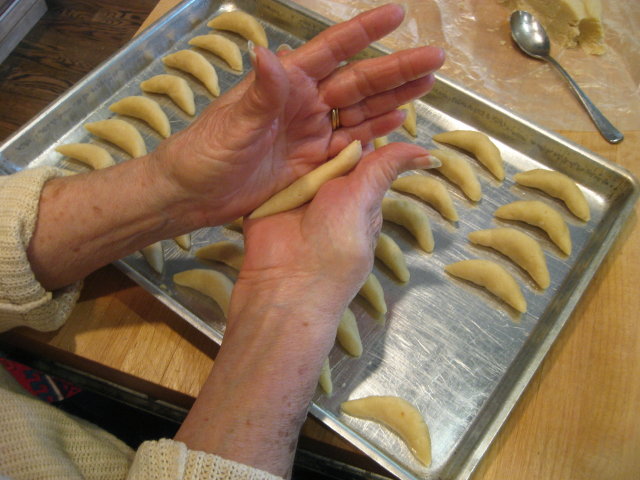
Roll the dough between your palms ....
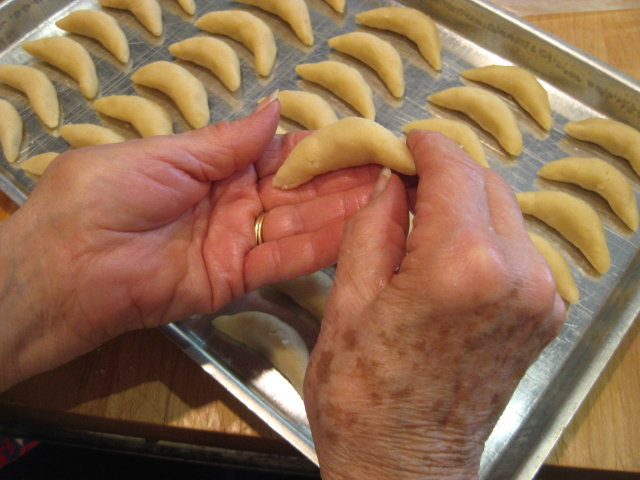
... and pinch the ends to form crescents

Place the crescents on a baking pan, leaving small spaces between them.  Bake for 15 to 20 minutes or until lightly colored.
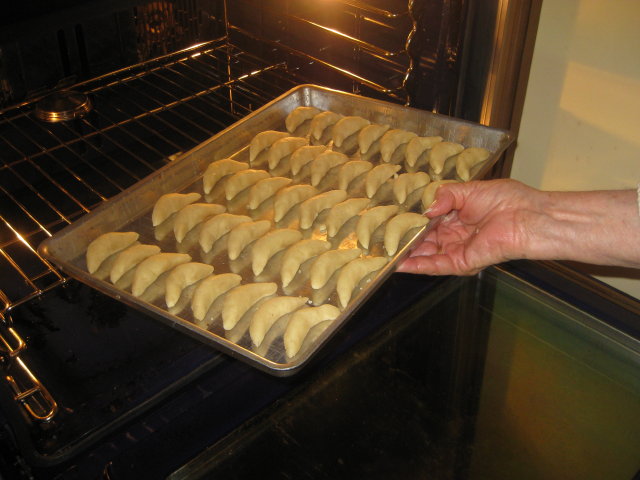
The cookies are baked for about 15 to 20 minutes until lightly colored

When cookies are slightly cooled but still warm, place them in the vanilla sugar, coating them completely, being careful not to break off the ends.  Transfer the cookies to wax paper on a rack or on the counter (so the sugar does not fall off) to cool completely.  Store crescents in an airtight container or cookie tin.  Sprinkle the excess vanilla sugar over the cookies, adding the scraped beans, to help preserve the vanilla flavor of the cookies while being stored.  Shake off excess sugar before serving.
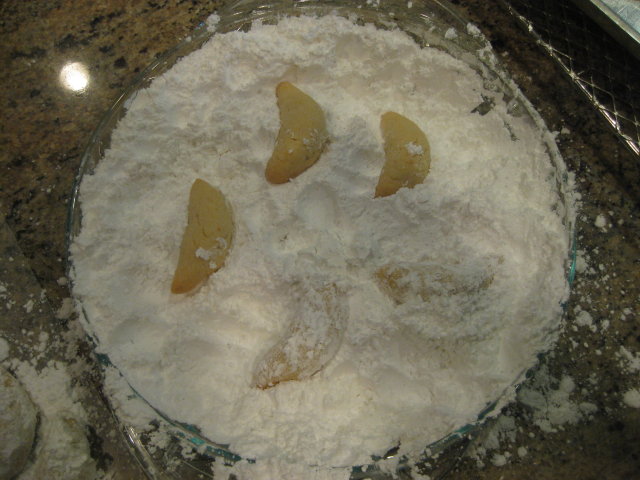
Carefully coat the slightly cooled cookies in vanilla sugar; save the vanilla sugar for storage with the cookies to enhance flavor
Posted in Uncategorized | Tagged , | 2 Comments

Amy Currie’s Summit Patch article — check it out!

My dear friend Amy Currie just wrote an article about my mother’s Lekuchen.

Thanks Amy!

Here is the link:

http://summit.patch.com/articles/lebkuchen 
Posted in Uncategorized | Leave a comment

Ruth’s Virtual Cookie Tin

So far, I have posted recipes for my mother’s Lebkuchen and Stollen. I am working on new posts for Ruth’s Viennese Vanilla Crescents, Hazelnut Balls, Cinnamon Stars, and Anise Springerle, and more…. Check back soon!

Posted in Uncategorized | Leave a comment

Stollen – Just Don’t Call it Fruitcake

Ruth's "Handgemacht" Dresden Stollen

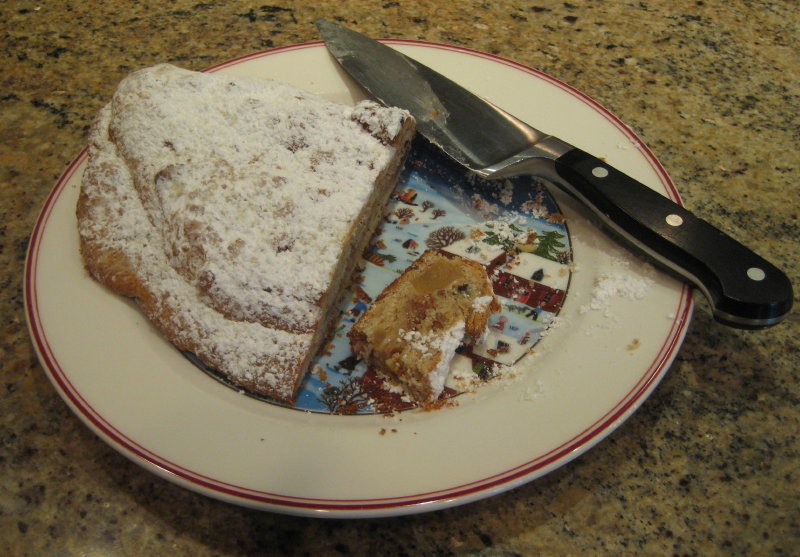
I am not a big fan of old-fashioned, heavy, rum-infused fruitcake.  Is anybody, really?  We’ve all heard the jokes about the dense, sticky store-bought brown cake that is rarely truly welcome as a holiday offering.  Admittedly, Stollen is a type of fruitcake, but it is not dense or brown or sticky – it’s a much lighter yeast bread made with almond flour and rum-macerated candied fruit.  The loaf is tapered at both ends and dredged in confectioners’ sugar.  Recently I read somewhere that the appearance of the finished Stollen is supposed to represent the Baby Jesus in swaddling clothing.  Well, I don’t know about that, but I do know it is festive to look at and extremely satisfying to eat.

My mother Ruth uses a Stollen recipe from a December 1977 issue of Gourmet magazine.  She has been making Stollen every holiday season since then — for 35 years now.  I asked her why she started making Stollen.  This is her story:

“In the late 1960s, I traveled to Germany with my father. While in Stuttgart, I met up with my cousin Inge, who took me to a local Konditorei.  At the Konditorei, I indulged in a piece of Dresender Stollen, and never forgot how incredibly good it was. (Coincidentally, the confectionery café I visited with my cousin back in 1966 was owned by relatives of the Steck family!) Eleven years later, in 1977, when I was flipping through my newly arrived December Gourmet, I saw a recipe for Dresden Stollen, and the light went on. I knew I had to try it. And I’ve been baking a triple batch every holiday season since then.”

Making Stollen is a labor of love, and a bit time consuming, but worth the effort. Wrapped well, it keeps in the freezer for months.  Anytime you can manage to indulge in a slice of handgemacht Stollen, the light will go on.

Ruth's Dresden Stollen, ready to be devoured....

Recipe for Dresden Stollen
Adapted from Gourmet Magazine, December 1977
Makes 2 loaves
Active time 1 hour; start to finish 5 hours

Ingredients:

For fruit filling:
½ cup diced mixed candied fruit or fruit peel
¼ cup golden raisins
¼ cup dried currents
¼ cup glace or dried cherries, halved
¼ cup dark rum

For dough:
1 envelope active dry yeast
3/4 cup milk total: ¼ cup warm milk for proofing yeast, plus ½ cup milk for later use in dough
½ cup granulated sugar for use in dough, plus ½ teaspoon sugar for proofing yeast
½ teaspoon salt
½ teaspoon almond extract
½ teaspoon lemon zest
1¾ to 2 cups all-purpose flour, using half at a time in two stages, plus more for flouring work surfaces and tossing with almonds and fruit mixture
1 cup almond flour, using half at a time in two stages
1 egg
¾ stick (6 tablespoons) butter, well-softened, plus more for brushing inside of loaves and buttering dough-rising bowls
½ cup slivered, blanched almonds, lightly toasted
¼ teaspoon cinnamon
confectioners’ sugar for dredging and dusting finished Stollen

Preparation:
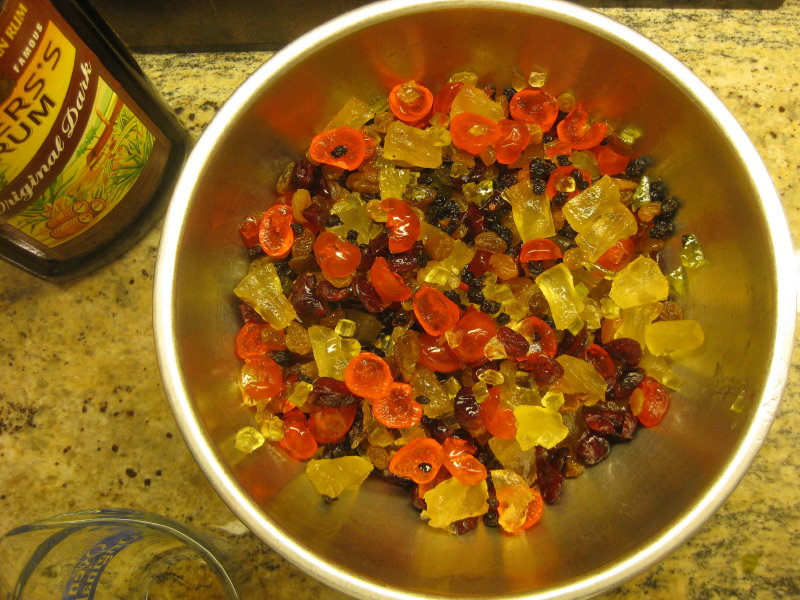
In a bowl combine candied and dried fruit, raisins, currents, and cherries with rum, and let the mixture macerate overnight.

mixture of candied and dried fruit, about to be macerated with dark rum

In a small bowl proof 1 envelope active dry yeast in ¼ cup warm milk with ½ teaspoon sugar for 10 minutes. In a saucepan (or use a bowl in a microwave using low to medium heat) combine ½ cup milk, ¼ cup sugar, and ½ teaspoon salt, cook the mixture over low heat, stirring until it is warm, and transfer to a bowl.

Drain the fruit mixture in a sieve set over the milk mixture, and stir the juices into the milk mixture with ½ teaspoon each of almond extract and lemon zest, and add the yeast mixture. Add ½ cup each of all-purpose flour and almond flour, stir the mixture until it is well combined, and let it rise, covered, in a warm place for 1 hour.

Punch down the dough, add 1 egg, lightly beaten, and ½ cup more each of all-purpose flour and almond flour, and blend in ¾ stick (6 tablespoons) of butter, well softened. Turn the dough out on a floured surface and knead it, adding ¾ to 1 cup flour, or enough to keep it from being sticky, for 10 to 15 minutes, or until it is smooth and elastic.

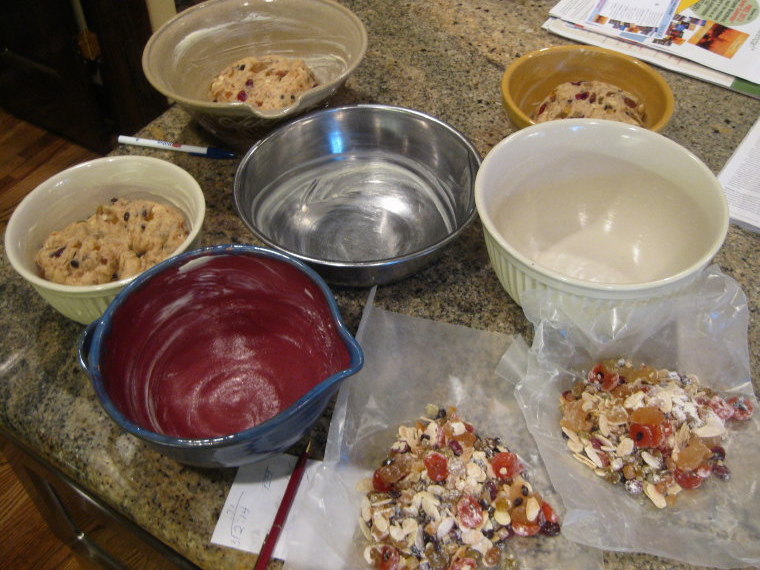
Spread the fruits on paper towels, pat them dry, and in a large sieve toss them with the ½ cup slivered, blanched almonds, lightly toasted, and 2 tablespoons flour. Halve the dough, form each half into a rough rectangle, and press the fruit mixture into each rectangle, folding and turning the rectangles several times to incorporate the fruit. Form the dough into 2 balls, put each ball in a lightly buttered bowl, turning the balls to coat them with the butter, and let the balls rise, covered in a warm place for 3 hours, or until they triple in bulk.

three bowls with drained macerateed fruit and almonds already incorporated into dough; fruit and almonds ready to be incorporated (this is a triple batch making 6 loaves)

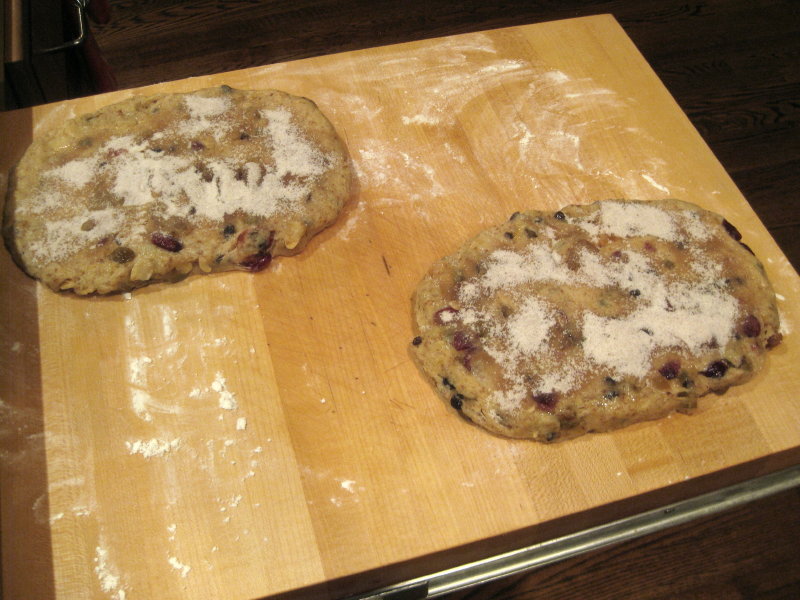
Press down the dough and roll each piece into a 9- by 5-inch rectangle on a well-floured surface. Brush the top of each rectangle well with melted butter, in a small dish mix ¼ cup sugar with ¼ teaspoon cinnamon, and sprinkle half the mixture on each rectangle.

two loaves just brushed with melted butter and sprinkled with cinnamon sugar; they will be folded over next, allowed to rise again, then baked

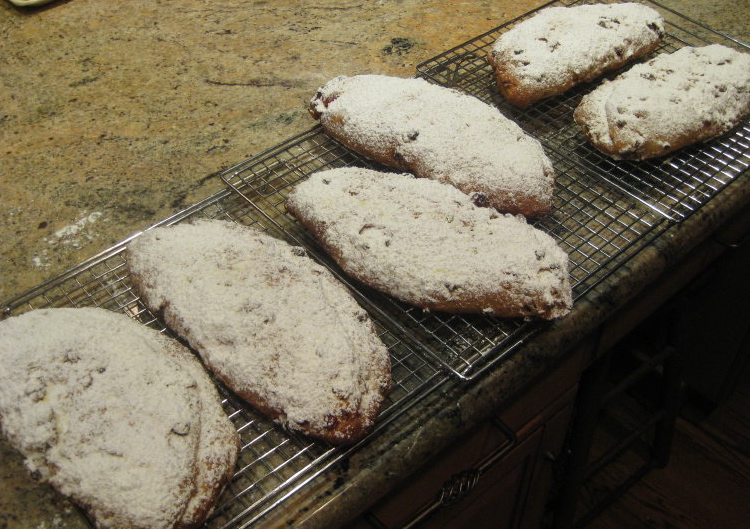
Fold a long side of each rectangle over the top, a little past the center and press up the folds but do not press the center edges down. Transfer the rolls, seam side up, to a buttered cookie sheet, leaving 4 inches between them, and let them rise, lightly covered, for an hour, or until they are almost double in bulk. Brush the tops well with melted butter and bake the Stollen in a pre-heated 375 degree oven for 30 minutes or until they are golden. Dredge the warm Stollen in confectioners sugar, transfer them to a rack and let them cool. The Stollen will keep, wrapped in plastic wrap and foil, for 2 to 3 weeks. They will keep even longer wrapped well and placed in the freezer.

the finished loaves, just dredged in confectioners' sugar

Posted in Uncategorized | Leave a comment

Lebkuchen, My Favorite

Christmas in the Steck household doesn’t officially get started until the first batch of Lebkuchen comes out of the oven. My mother Ruth has been making this traditional German holiday treat since I can remember, and recently kicked off her family’s 2011 holiday season by baking a triple batch. Age does not seem to slow my mother down. She is an inspiration, in many ways.

My parents grew up with holiday traditions rooted in German and Austrian cultures. My mother’s father, Herman Voellm, was born in southern Germany, as were both of my father’s parents. My mother’s mother was born in Austria, near the Polish border. All my grandparents immigrated to the States after World War I, landing in the New York and Philadelphia metropolitan areas. My parents met as young adults at a family reunion picnic, as the story goes, because my grandfathers knew each other as boys living in the same small town of Moehringen, near Stuttgart, Germany.

When Ruth was growing up in the Philadelphia area, Lebkuchen was a special treat brought into her home during the holidays, but she never found a recipe or baked them herself until she got married in the mid-fifties. While they were newlyweds, my father was in the U.S. Air Force, stationed in England, and he bought a copy of the original edition Gourmet cookbook, first published in 1950. He brought the cookbook home for his new wife, and when my mother saw the standard Lebkuchen recipe inside, she decided to give it a try. Ruth has been using this original 1950 recipe since then, tweaking it over the years to suit a modern kitchen.

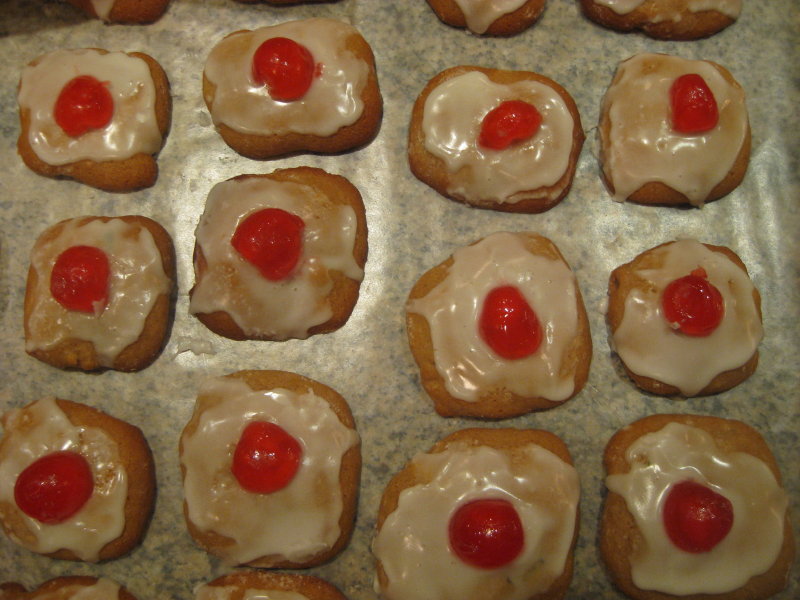
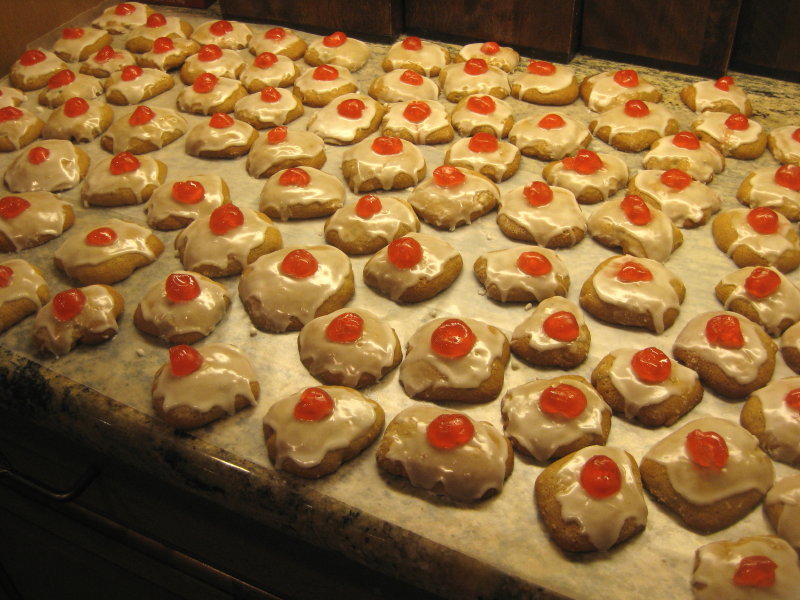
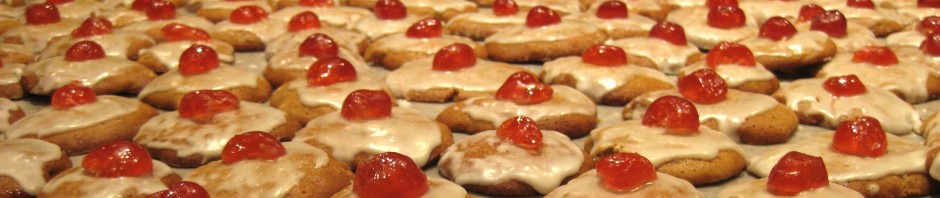
Lebkuchen is a pleasantly soft and chewy gingerbread type of cookie, although ground ginger is not an ingredient in Ruth’s recipe. The complex flavor is derived from such ingredients as honey, ground almonds, cinnamon, cardamom, nutmeg and cloves. The warm, just out of the oven cookies are iced and decorated with candied cherries or sliced almonds. The cookies last for weeks, long after the holidays are over.

the finished product

To me, Lebkuchen are my mother’s “signature” holiday cookie. If I had to choose one cookie for the holidays, that would be it. My brother Paul agrees — no surprise there. He cleverly compares our mother’s Lebkuchen to the fountain of youth:  “One aromatic and existential bite refreshes the memories and releases the timeless spirit of Christmas,” he teases in an email to me. Too much? Not really. It’s all true.

It’s not just me and my brother who are passionate about Lebkuchen. They have been a popular holiday choice for centuries, baked in German monasteries since the 1200s. The city of Nürnberg is today famous for its commercial Lebkuchen production, and it is believed the cookies were first called Lebkuchen there in 1409.

If Lebkuchen are the starting point for the holidays in the Steck household, then the magic of Christmas, with all its family memories, is sure to come soon … along with plenty more cookies.

Lebkuchen Recipe

This recipe is based upon a Gourmet Cookbook recipe, originally published in 1950. The recipe makes one batch or about six dozen cookies. Once combined, the dough needs to sit before baking for 24 hours and up to 72 hours at room temperature to ripen and mellow. Citron, a candied fruit, is usually available during the winter holidays at major grocery stores. Cardamom seeds are also usually available at major grocery stores; ground cardamom can also be used but the crushed seeds give a much better flavor. The ground almonds can be bought pre-ground, or you can buy slivered blanched almonds and grind them in a food processor with a little white sugar; do not over process to a paste. Lebkuchen keep, tightly stored at room temperature, for weeks and even months. The baked cookies taste best a few days after baking, allowing all the flavors to meld together.

Ingredients:

For the dough:
1 cup honey
¾ cup packed brown sugar
1 tablespoon lemon juice
1 teaspoon lemon zest
1 egg
2 ½ cups sifted flour
½ teaspoon baking soda
½ teaspoon ground nutmeg
½ teaspoon ground cloves
1 teaspoon cinnamon
½ teaspoon crushed cardamom seeds
1/3 cup chopped citron (candied)
1/3 cup ground blanched almonds

For the icing (approximate amounts):
1 ¼ to 1 ½ cups confectioners sugar
2 teaspoons or more lemon juice
2 tablespoons heavy cream

For decoration: Use candied fruits or nuts to top the icing. Halved candied cherries are both festive and colorful.

Directions:

In a small bowl sift together the flour, baking soda, nutmeg, cloves and cinnamon, and set aside. Measure and set aside the cardamom seeds, citron and ground almonds.  (The cardamom can be crushed using a mortar and pestle or by placing the seeds in a Baggie and pounding them with a small hammer or metal pounder.)

Scald and cool the honey (liquefy in a saucepan or set in a bowl in a microwave oven at medium). Using a large mixing bowl, mix together (with large spoon or spatula, no standing mixer required) the honey, brown sugar, lemon juice, and the lemon zest. Add the egg, already beaten, to the bowl, beating again it to combine. Gradually add the flour mixture, blending until combined. Add the crushed cardamom, seeds, chopped citron, and ground almonds and mix until combined. Cover the bowl and let stand at room temperature for 24 to 72 hours before baking.

When ready to bake, pre-heat the oven to 400 degrees. Butter the cookie sheets.

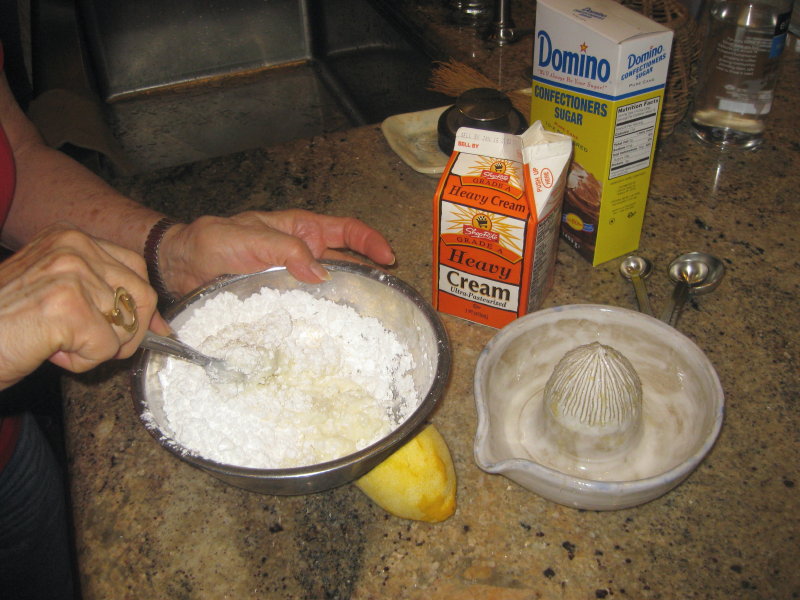
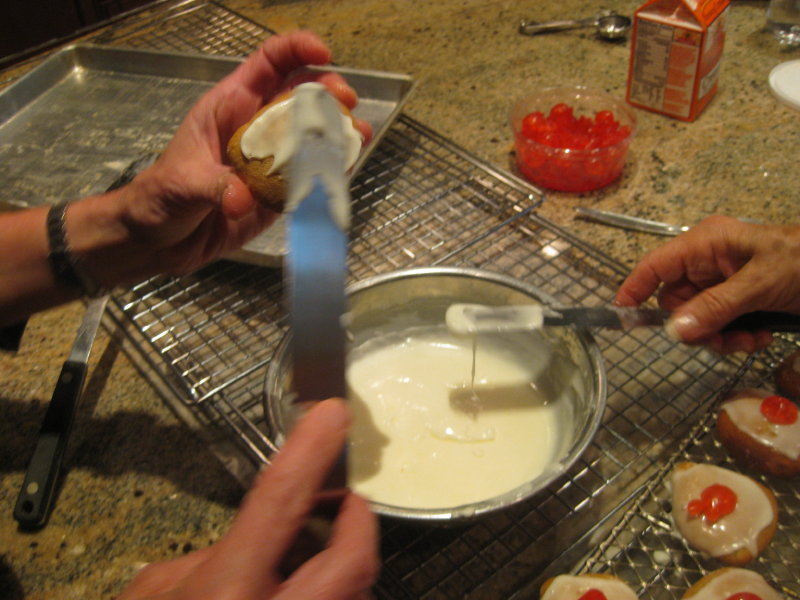
Prepare the icing: Mix confectioners sugar, lemon and cream with a fork or a small whisk in a bowl until smooth and free of sugar lumps.  Icing should be opaque when spread on the warm cookie. Add more sugar as needed.

making the icing

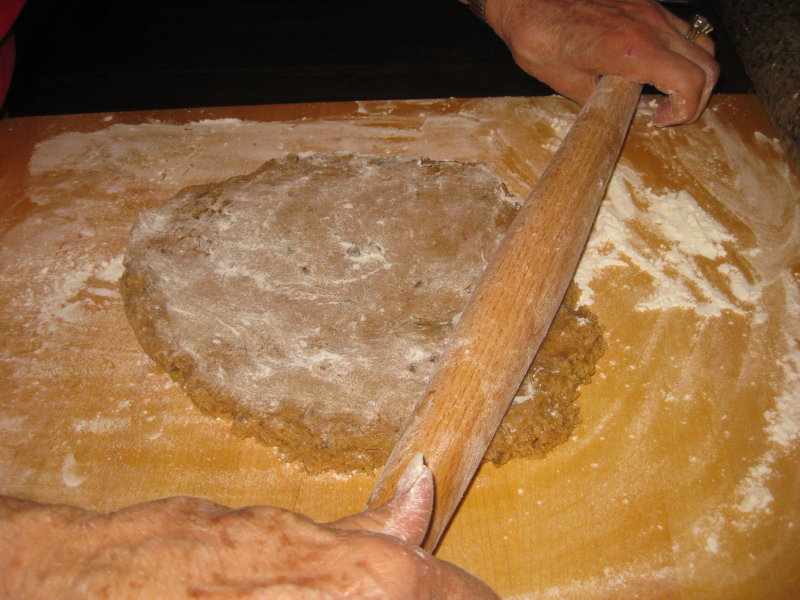
Roll the dough, using about 2 cups at a time, on a floured work surface, into a sheet ¼ to ½ inch thick. Use a floured rolling pin (or your floured hands) to press the dough into a workable disk. If the dough is too soft, stir in a small amount of flour, making it easier to work with.

rolling out the dough on a floured surface

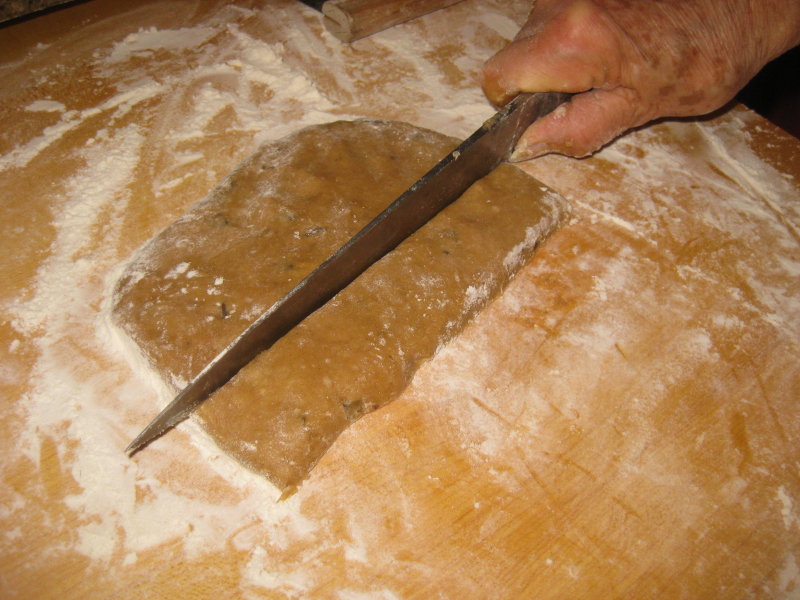
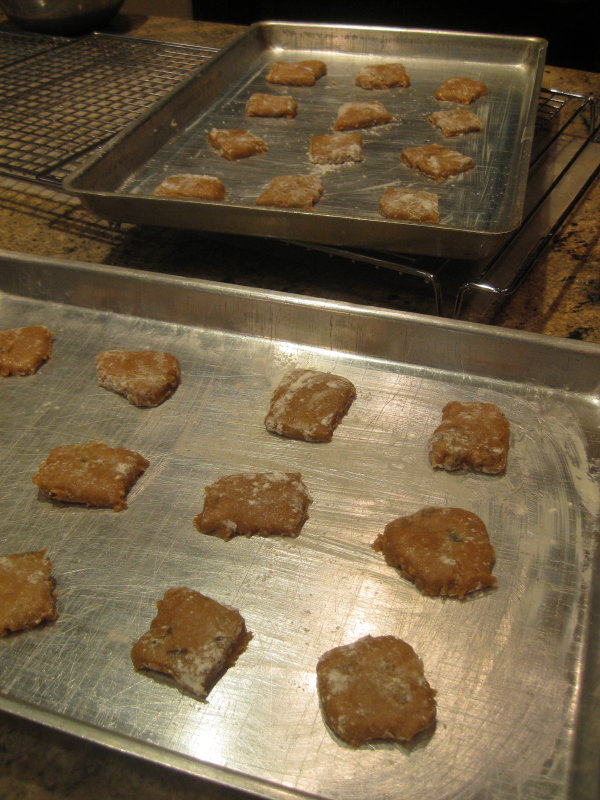
Cut the dough into bars or squares using a long, sharp knife, or cut the dough using round or heart shaped cookie cutters. Flour the cutting utensils. Re-mix the scraps into the bowl, so they are not wasted. Cookies will round out and puff up while baking.

cutting the dough into cookie-sized squares

ready to go into the oven

Bake the cookies until very lightly colored, about 7 to 8 minutes, depending on how many cookies and cookie sheets are in the oven at one time. Transfer the cookies immediately to cooling racks. Ice and decorate the cookies while they are still warm. Optional: Place sheets of wax paper under cooling racks to catch the icing drips, making clean up easier.

icing the warm cookies

Allow the cookies to cool and the icing to dry completely before storing in tins or other airtight containers. To maximize freshness, line stored layers of cookies with wax paper. The texture and taste of Lebkuchen improve with age. Wait a few days after baking to consume, if possible. Enjoy — morning, noon and night!

let the cookies cool and dry completely before packing in tins

Posted in Uncategorized | 2 Comments

Let the holiday baking begin!

Since I can remember, my mother Ruth baked dozens of varieties of Christmas cookies in preparation for the winter holidays.  She stood in the kitchen for hours at a time, sometimes well past midnight, baking until she had created countless sheets of cookies like edible works of art.  My brother, father and I greedily consumed the gourmet goodies as the holidays approached, but my mother also made and set aside plenty of her cookies to give away as gifts, wrapping each variety individually and packing them in decorative holiday tins.

Most of the cookies my mother bakes are German or Austrian in origin, especially the types she has been baking since I was a very young girl.  Every few years she would add a new variety or two, experimenting with current recipes. All of her creations are  exquisite in taste, texture, and appearance, and painstakingly crafted.

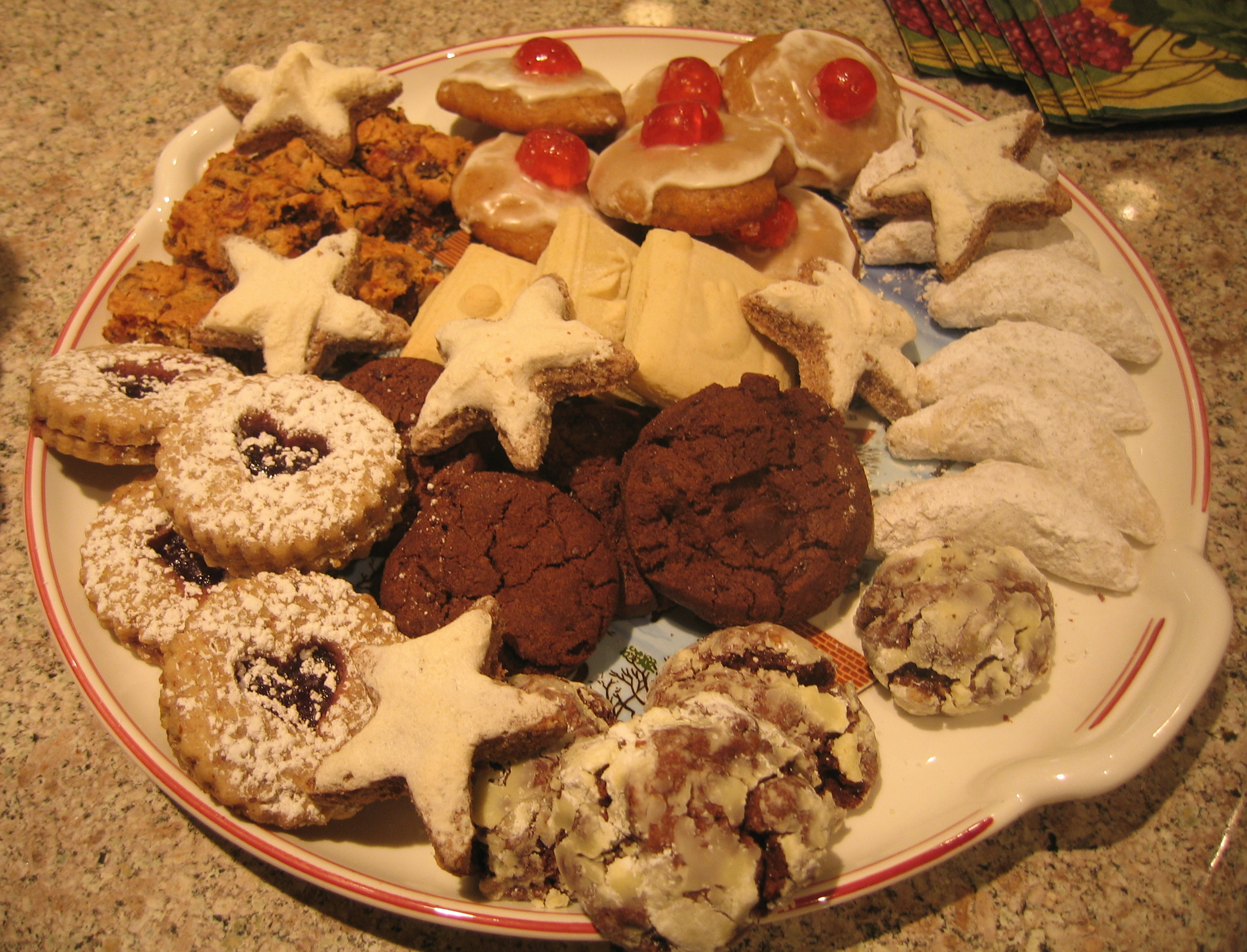
Ruth’s classic holiday baking portfolio includes: Lebkuchen, Stollen, Hazelnut Balls, Viennese Vanilla Crescents, Cinnamon Stars, Date and Nut Sticks, Anise Springerle, and Linzer Cookies. She also makes Ginger Snaps, Licorice Crinkles, Lemon Meringues, and Chocolate Korova Cookies. In addition (phew!), Ruth painstakingly creates festive and entirely edible Tannenbaum Cookie Trees to decorate the dining room table for our Christmas Eve traditional goose dinner.

My mother’s tried and true recipes are copied from old Gourmet cookbooks and cooking magazines, many with baker’s notes scribbled on them, and stashed away in a manilla folder for safekeeping.  I think it is high time to catalog, digitize and publish them, so these recipes can be used, shared and enjoyed.

My mother has just started her holiday baking again this year, and has agreed to share her recipes with you, with personal tips and suggestions. My father is the cookie photographer. I think it is most appropriate to start with German Lebkuchen, a delicious iced gingerbread cookie that just gets better with time.

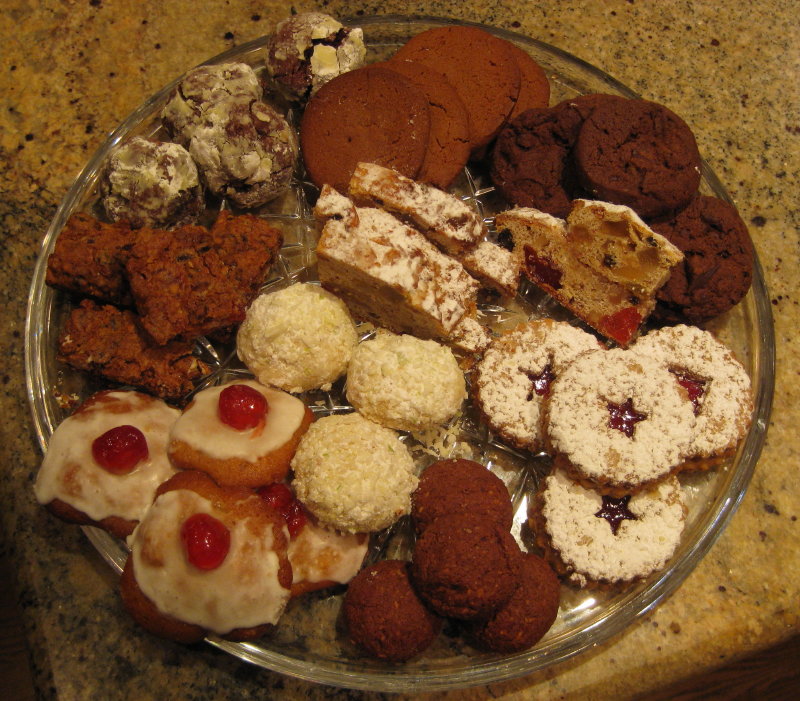
Ruth's Christmas Cookies

Posted in Uncategorized | 5 Comments